Search This Blog

11 February 2024

'Twas a long Parting — but the time


'Twas a long Parting — but the time
For Interview — had Come —
Before the Judgment Seat of God —
The last — and second time

These Fleshless Lovers met —
A Heaven in a Gaze —
A Heaven of Heavens — the Privilege
Of one another's Eyes —

No Lifetime — on Them —
Appareled as the new
Unborn — except They had beheld —
Born infiniter — now —

Was Bridal — e'er like This?
A Paradise — the Host —
And Cherubim — and Seraphim —
The unobtrusive Guest —

F691, J625, Fascicle 32, 1863


Before saying anything else about this poem, I want to focus on the line “Born infiniter — now —"  This line, following on the heels of the previous poem, “Forever is composed of Nows,” has the potential to usher you into the eternal moment of which all of the mystics speak. Both lines move from the infinite to the present. In this one, you are born MORE infinite in the present as you gaze into the eyes of another. To be infiniter is a kind of joke, since it is impossible to have more infinity. But, you can, perhaps, become more aligned with the infinite, become infiniter, when you fully enter into the moment, because in that moment you are letting go of the past and future, and therefore of time. You are parting from time. This might be especially true while gazing into a lover's eyes. 

Now onto the rest of the poem. The first line of the poem, “'Twas a long Parting — but the time” is full of potential meaning. In a poem about the infinite and the now, we already see the idea of time and the leaving of it. And in a poem about lovers, we have introduced the idea of parting. Before we even go on to the next line we are given much to think about. It would be something to try to map out and diagram every thought you had while reading a Dickinson poem. There have been, I would guess, at least a thousand thoughts engendered in my mind so far by this one poem. All of this thought adds up to a “take”, though the complexity of the individual nuances of that take involve each and every one of those thoughts. What I’m trying to say is that with a Dickinson poem, and especially one of this sort, you can try to map out the route, and you can try to include a “general” reading of the poem, but in the end it’s nigh impossible. This is part of the reason why I’m so taken with Susan Kornfeld’s essays on this blog. She’s able to come to a relatively general conclusion that doesn’t subsume or overpower the reader’s own intimate and unique take on it.

That said, I will try to give what I see as the surface reading of this poem: 

It was a slow death, but finally the time for the interview to get into heaven had come. Before the judgment seat of God stood two fleshless lovers. It was the second time these lovers had met. They gazed at each other and heaven itself was in that gaze, the heaven of heavens. Looking into one another’s eyes was a privilege. The bodies are newly unborn, or rather they are born more infinite each moment they look at one another. Was there ever a wedding in the flesh that could compare with this? In this moment, as the host becomes paradise, the lovers welcome the angels, as long they don’t bother them that is.

I'm doing a lot of damage to that third stanza in this summary. There is so much sliding syntax in that stanza that you could punctuate it in several ways. For instance, would a period go after "now" or does "now" modify the first word of the next line, "Unborn"? It's almost as if Dickinson has to break the logic of language in order to get through to something some ineffable truth.

Aside from just the slippery syntax, this poem is weird in other ways. First of all, why was it a slow parting? (Perhaps it felt slow because the lover wanted to get to heaven to meet again with the beloved?) Why was it the second time they met? Is it the second time they’ve met at all, or the second time they've met without flesh? Is this someone the narrator has only met once before? If it’s only the second time they've met as fleshless lovers, when was the first time? If the lovers are before the judgment seat of God, why are they looking at each other instead of God? The way the syntax of this poem is set up, it appears at first as if God could be the lover in question. (This idea is repeated and bolstered in the poem, since the lover’s eyes are heaven.) If God is the lover, then is God the beloved or is the beloved God? And either way, why is the beloved a judge? What is judgment even doing in this poem? Also, how would you have eyes if there was no "Lifetime" on them? (One way would be as a reader because when we read Dickinson’s poems it does feel a bit as if we are gazing deep into her fleshless eyes.) And maybe the most obvious question is: what's up with imagining life after death?

The questions abound, and I'd be curious to know if any of you have a good answer to any of them.  But if I put those questions aside, put my logical sensibility aside, what I’m left with is something beyond mere logic, an exhilarating impression of the True Wonder of staring into someone’s eyes, the absolute privilege of it, the intense nowness of it, the disembodied forever feeling in it, the wedded bliss inherent, like paradise, like heaven, like the heaven OF heavens. When we gaze into one another’s eyes it is as if we are the newly unborn, born infiniter. (What a way to say it!) This poem must be one of the most romantic poems ever written. I'll remember it the next time I stare into someone's eyes.


-/)dam Wade l)eGraff


Portrait of Emily as a child. The eyes have it.


06 February 2024

Forever – is composed of Nows –


Forever – is composed of Nows –
‘Tis not a different time –
Except for Infiniteness –
And Latitude of Home –

From this – experienced Here –
Remove the Dates – to These –
Let Months dissolve in further Months –
And Years – exhale in Years –

Without Debate – or Pause –
Or Celebrated Days –
No different Our Years would be
From Anno Dominies –


F690, J624, Fascicle 32, 1863


I love it any time Emily Dickinson takes on “eternity” as a subject. I find her spin on it dizzingly powerful. That first line is a good example. It simultaneously zooms out to Forever and zooms in to Now, and by conflating the two shows us both that there can be nothing more than the moment, and, conversely, that the moment is worth extra consideration because it is our actions in the moment that “compose” forever. That verb "compose" brings to mind writing...or music. 

The second line is a good example too. “Tis no different time” is a sliding modifier. When taken after the first line it modifies "now". It says: there is no different time than now. BUT it could ALSO modify the “infiniteness” of the third line. Taken that way it says: there is no other time than infiniteness. That sliding clause further conflates now with forever. In this nifty way the poet weaves the concepts together. There is no other time than now, and there is no other time than the infinite. See? It's dizzying.

Lines 3 and 4 move over to the realm of space instead of time. Just like you have now and forever in the realm of time, you have home and infinity in the realm of space. Forever:now::Infinity:home. It’s almost as if she is intuitively anticipating the "Space-time" of Einstein’s Special Theory of Relativity. (Math nerd alert! I imagine she and her sister-in-law Sue, a mathematician, had some mind-bending conversations about infinity.)

The choice to use the word infiniteness instead of the usual noun, infinity, seems fitting, as the “ness” gives the word "infinite" a quality of spaciousness.

“Latitude of home” would be a paradox in the realm of infinity, because how can you have any latitude in an infinity? You can only have a "latitude" in the same way we can have a “now”, from the vantage point of your own seat of perception. We can only measure where we are by where we commonly (and individually) perceive ourselves to be. What the word “latitude” seems to point to, here, is your internal home.

Latitude has a second definition which bolsters this idea. Latitude can mean “scope for freedom of action or thought” So I think home here could also be the place where you are free to think in the way you want to. And perhaps that is what it means to find your way home internally. Dickinson never ceases to amaze me with her word choices.

The next line of the poem, the beginning of stanza 2, is yet another sliding modifier. (There are at least 3 in this poem). The line, "From this – experienced Here –", can either qualify the line above it or below. When I tried toggling back and forth between the two, above and below, the line began to hover, suspended between the past and the future:

And Latitude of Home –
From this – experienced Here –
Remove the Dates – to These –

See how it just floats there in the middle? After going back and forth the mind settles down on that capitalized "Here". It would be a terrific mantra, wouldn't it? 

Lines 7 & 8 are so relaxing. Let months dissolve into months and years exhale in years. The language here is the language of letting go. Exhale and dissolve. You let go of time here and just flow. 

Can you argue with letting go? You could try. But the 3rd stanza anticipates your argument and answers it flat out with: "No debate." Then it goes further, "No debate...or pause." Why is there no debate? Because there is no pause. You can't pause time. It's going. No debate, so you might as well go with it.

There are three negations in a row in the first two lines of the third stanza and they are all making different, but interrelated points. There's a very condensed logic packed into this stanza.  There is no debate, no pause, and no celebrated days. Notice that these two lines are a third sliding modifier in this poem. They can either qualify the lines above them or below them. 

The last negation, "no celebrated days" is a very Buddhist thought. If every moment makes up forever, then either we celebrate every moment or none. It's Christmas every day is what I think Dickinson slyly implies when she writes  "No different Our Years would be/ From Anno Dominies"* 

Though I had never read this poem before, I did know the first line, which pops up as a quote here and there. I start my HS classes out with a 3 breath meditation and sometimes I'll say this line during the meditation. "Take a slow deep breath in. Stay with the breath in the present. Remember that Forever is composed of Nows." Next time I'll add, "Exhale and dissolve." 


_-/)dam Wade l)eGraff


*Anno Domini (A.D.) implicitly refers to Christ's birth, so the use of the plural here, "Anno Dominies" may be implying that Christ is born anew every year. There is a fascinating theological idea in Dickinson's poetry of Christ being born and crucified continually, in each of us. Cf. F372 "The stiff Heart questions 'was it He that bore (the cross) and 'Yesterday, or Centuries before?" And in F670, Dickinson writes that there is only one Crucifixion recorded, but there are as many as there are persons.)


04 February 2024

It was too late for Man—


It was too late for Man—
But early, yet, for God—
Creation—impotent to help—
But Prayer—remained—Our Side—

How excellent the Heaven—
When Earth—cannot be had—
How hospitable—then—the face
Of our Old Neighbor—God—        +New


F689, J623, Fascicle 32, 1863


“It was too late for Man”. Now that’s what you call a cold open! This would imply mankind is doomed, and perhaps it seemed so to Emily in the midst of a civil war in which brother was fighting brother, and over such a terrible issue as slavery. But this line has only come to feel more apropos nowadays with climate change, nuclear weapons, the threat of AI, and so on. Emily saw the writing on the wall. Humanity, left up to its own devices, appears hellbent on self-destruction.

But then you get that big “But’ in the next line. “But (it’s) early, yet, for God.” That’s reassuring. We are a blip in the broader manifestation that is happening in the vast universe. I saw a t-shirt worn by the comedian Reggie Watts that said, “When in doubt, zoom out.” That’s what Emily seems to be doing here, taking the long view.

Not only is it too late for man, but we read in the next line that Creation is impotent to help. In the line following this one we get our second big but, "But Prayer—remained—Our Side—" One would think Creation being impotant to help might negate prayer. Creation is not taking care of us, so what makes us think prayer will help? You could read the line “Prayer remained our side” as hopeful, but you can also read derision there. Take the “our side” qualifier for starters. What does it imply? It reminds me of that deeply sarcastic Bob Dylan song, “With God on our side”. Any time you have sides, you have disparity. Still, I like the hopeful possibility, and if you think about the prayer as applied to ourselves, to "our side", where it must "remain", then the prayer is for us.

This poem can also be read as taking the short view too. The Man called out in the first line may be Man in general, but it may also refer to the singular man or woman. When it is too late for you, when you have exhausted your own human limitations, then that’s when God can get to work.

That's the premise. Let’s see how Dickinson will use the second stanza to comment upon and modify the first. When we read “How excellent the heaven” right after reading man is doomed and Creation is no help, then we are tipped off that the adjective "excellent" might signal sarcasm. But then we take in the next line, “How excellent the heaven/ When earth cannot be had.” This is a caustic aphorism. We idealize a future heaven, when life is hell, instead of focusing on the present. Dickinson comes back to this point often in her poems. I'm reminded here of Whitman's line too, “There will never be any more heaven or hell than there is now.”

The last couplet is tricky. But here’s where we may find a sharply pointed lesson. When we reach this “excellent heaven” our old neighbor God will be hospitable. What does Dickinson mean by our “old neighbor” God? Why is God an old neighbor we wonder? Then a possible meaning occurs; the reason earth can be hell is BECAUSE of our old neighbor, because of man’s inhospitality to man. In a heavenly place our old neighbor would be welcoming. God is not somewhere out there, but can be seen in the face of the neighbor. “As you do for the least of these, you do unto me.”

To extrapolate further, we might say that it is in BEING a good neighbor ourselves that we might “save mankind.” But it's not man saving man here, since man is past help. It is God, the Divine within us, which, as the second line of this poem reminds us, has only just begun.

It’s worth noting that the alternate word for “Old” in this poem is “New”. We saw something similar in the previous poem with "last" and "first", where Dickinson provides an opposite as an alternate word choice. “New” would have worked well here too, as it would still call to mind for us the “old” neighbor. But changing the word to “Old” complicates the poem, as we get a conflation of the neighbor that made earth hell with God, but it also enriches the poem because it leads us to see God in the old neighbor, and, perhaps, the old neighbor in God.

A note about scansion here. This poem has a unique 3343 3353 meter. I think the elongated pentameter of the 7th line puts emphasis on the extra word in that line, "then". "How hospitable—then—the face." "Then" is also emphasized by the dash on either side of it. The word "then" can be read as the turning point of the poem, so the extra metrical and syntactic emphasis here helps push the meaning toward its conclusion. Here, now, love your neighbor as yourself.

-/)dam Wade l)eGraff


03 February 2024

To know just how He suffered – would be dear –


To know just how He suf –
fered – would be dear –
To know if any Human eyes
were near
To whom He could entrust
His wavering gaze –
Until it settled broad – on
Paradise –

To know if He was patient –
part content –
Was Dying as He thought –
or different –
Was it a pleasant Day
to die –
And did the Sunshine
face His way –

What was His furthest mind –
of Home – or God –
Or What the Distant say –
At News that He ceased
Human Nature
Such a Day –

And Wishes – Had He any –
Just His Sigh – accented –
Had been legible – to Me –
And was He Confident
until
Ill fluttered out – in Ever –
lasting Well –

And if He spoke – What
name was Best –
What last                               +first
What one broke off with
At the Drowsiest –

Was he afraid – or tranquil –
Might He know
How Conscious Consciousness – could grow –
Till Love that was – and
Love too best to be –
Meet – and the Junction
be Eternity                            +mean


            -F688, J622, Fascicle 32, 1863 

            -lineated as originally hand-written by Dickinson.*


This is a meditation on that liminal moment just before death. I read it as aspirational. Whose death the poet is considering isn't important. Ultimately, it is the reader’s own that is in question. The choices the poem implicitly presents are conditional. How much will you suffer at death? That first question, alone, might stop us in our tracks. Next question: who will be with you when you die, and will it be someone strong enough that they will be able to steady and stay your eye, to help you transition to paradise? Will you have the requisite patience? Will you be, at least in part, content? Will the sun be shining? And more importantly will you still be able to feel it, still be able to feel what is pleasant? The conditional starts to tip toward the imperative.

Then in the third stanza there’s a more explicit question. When you are on your death bed, will you be longing for Home or looking forward to Heaven? Will your mind at death be on Home or God?

“What was his furthest mind -- Love or God” has two possible meanings. It might mean “Is it Love or God that is furthest from the mind?” or it might mean, “Is it Love or God where the mind has gone the furthest?” Here we have a sliding modifier. Does “further” mean further away, or further towards?

But either way, the next lines suggest an answer, that it is most likely Love the dying one is thinking of, because God, and the future, are unknown. We see this in the question, “What (does) the Distant say –At News that He ceased/ Human Nature/ Such a Day”? Does the "Distant" even register that we are gone? Care, if we are fortunate, is near, here. It’s not in the distant heaven, but close at home where our heart is. “The Infinite power of Home” is the way Dickinson puts it elsewhere.

More questions. What about last wishes? Will you have any? And what will your last wishes be?

All of this great and weighty matter will be summed up in the pivotal moment, and made obvious, by the mere accent of your sigh. The poet is wondering what the dying person’s (your) sigh portended (will portend.) Something else comes through in these lines too. There's an intimacy. The poet can tell what the dying is feeling even by the accent of his sigh. This is an important element to the poem. What is the relationship between the one wondering and the dead? The familiarity intimates love. Our perspective of the dying here, even if, ultimately, the dying is ourselves, is shown to us from eyes of concern.

“Was He confident until Ill fluttered out into ever lasting well” is a great line. The interrogative “W”s have been building in this poem and come to a head in this stanza, so that there is a wallop to that “was” and “well” beginning and ending the sentence. Also, the “well” caps the internal rhyme in the line of “until” and ill”. Then there is the word choice of “fluttered”, a verb which suggests so much, the trembling of death throes as well as an angel’s wings.

All of that poetry put in service of asking: will you be able to hold onto the Good (& well) in the face of the Terrible (& ill)?

Stanza 5 comes back to asking, who will be your dearest one? Who, in the end, will be the last person on your mind? There is a very interesting alternative word choice here for “last”, which is “first”. The first name on your mind in the presence of death is also your last.

The final stanza asks whether the one dying was (will be) afraid or tranquil? Death, for most of us, is scary, but we are attempting to prepare ourselves for a tranquil exit. We want to be like the first Thane of Cawdor, of whom Malcolm said, “Nothing in his life like became him like the leaving it.” I’ve heard it said that our whole life is but a preparation for our death. If so, the questions in this poem may lead the way.

I love the question, “How conscious will consciousness grow?” That question might be being asked here about the afterlife; will we still be conscious after we die, and will the consciousness then become more conscious? The question could also be asked of the dying, the not yet dead: How conscious has your consciousness grown? Are you conscious enough to be at peace? The question is speculative, and maybe even hopeful, if applied to the afterlife, but it is transformative when applied to the self before death.

As if all of that death meditation had not been enough, Dickinson hits us between the eyes with the final thought.

Will our conscious mind grow so conscious that it finds the crossroads between the love we felt in the past and a future perfect love, the love “too best to be” (the superlative love that may not even exist as anything but an ideal). The place where those two meet, says the poet, is “eternity”, which I take to mean the eternal present. This sets us up perfectly for a poem coming up, Fr 690, which begins with the line, “Forever is composed of Nows”.

One more detail worth noting about this poem. It's very minor, but it made me smile. After every stanza there is a dash, until the last one. This is fitting since the poem ends on the word Eternity


- /)dam Wade I)eGraff


  "Deathbed Scene" -Octave-Toussert, 1850


* This poem is a good example of how difficult it can be to lineate Dickinson's poems. This poem suggests pentameter, but the meter breaks down in the third stanza where the lines appear to be deliberately truncated and capitalized. So you either stick with the poem as hand-written, or you get creative with line breaks. After some deliberation I went with the former.


02 February 2024

I asked no other thing —


I asked no other thing —
No other — was denied —
I offered Being — for it —
The Mighty Merchant smiled —     +sneered

Brazil? He twirled a Button —
Without a glance my way —
“But — Madam — is there nothing else
That We can show — Today”?


               Fr687, J621 1863 (fascicle 32)


It’s always dangerous to reduce Dickinson’s poetry to a prose translation, but for the sake of a starting place, let’s try: “I only asked for one thing, but I didn’t get it. EVERYTHING else was available, everything except that ONE thing. I even offered myself, my own being, for this thing, but that Mighty Merchant, God, just sneered and smiled. How about if I give you Brazil instead, He asked. No, that’s not going to work for me, I said. The Merchant twirled a button, like a slick but bored businessman, and said, “Isn’t there anything else you might like, ma'am?”*

I read this ironically. Would you really expect a Mighty Merchant to give you what your soul truly desired? You’re probably not going to find THAT when you are dealing with a merchant. Merchants are generally out to get the best deal. What’s love got to do with it? Seeing God as a Mighty Merchant is sardonic. It’s like saying that everything from the top down is supply and demand economics. But, alas, in this world it does often seem that way. The powers-that-be are the very opposite of what true divinity should be; i.e. merciful and loving. God here isn’t the antithesis of the world, he IS the world. The Mighty Merchant (if, indeed, you take the Mighty Merchant to be God here) is a pseudonym for “Power”, for might makes right, for law of the jungle. It’s cynical, but hey, spurned love can spin you that way.

I love that button twirling detail. We might twirl a button if we are bored, and in that case it is a dismissive gesture. But we might also do it if we were considering the deal, in which case there's hope. The poem ends without an answer to the plea.


I asked Bing for an image of "God the Mighty Merchant, in striped suit and curled mustache, smiling and twirling a button on his sleeve. He is dealing with Emily Dickinson. Brazil is on the table.  Pre-Raphaelite style."

What is the one thing the Poet wants? One can only speculate, but here’s my best guess. I recently read “Open Me Carefully”, the collection of Emily’s letters and poems written and sent to Susan Huntington Gilbert over a thirty-year span. What a unique love story. Through the mediary of Emily’s brother Austin, who lived next door and was married to Susan, both women were allowed to see each other and continue their ever deepening relationship, from young school girls all the way to the end when Susan helped prepare Emily’s body for the grave. Perhaps Emily and Susan could have gone against societal mores and lived together, but seeing the difficulty that would have been involved in such a relationship in Victorian society, perhaps this nifty arrangement was the next best thing. Seen in that light, it’s a kind of miracle they were able to continue as they did. 

But if Sue was right next door, it must have felt, on some days, as if she was a million miles away. Susan was also, after all, a wife to Austin, a mother of three, a math teacher and a social butterfly.

So, while it could be a number of things, I think it might be Susan that Emily is asking the Mighty Merchant for, the one she’s willing to give her own being for. It’s the one thing she wants and can’t have. Why can’t she have it? It’s not for sale, for one. Even at the cost of one’s self. Everything else is, but not love. And none of those other things count. 

This is a funny poem, with a light touch, so it’s hard to take the pathos in it too seriously. I notice in the letters to Susan that Emily often uses an arch over-the-top tone to convey feelings that really ARE over the top for her, but are also, at the same time, held in check with humor. This poem seems of that kind. I think it is because at some deeper level she did have Sue that she COULD be so funny about not having her.

Also, from early on in the letters, Emily conflates Susan with God in a playful way. Consider this passage from a letter from 1852 when they were both 22. “How vain it seems to write, when one knows how to feel - how much more near and dear to sit beside you, talk with you, hear the tones of your voice - so hard to ‘deny thyself, take up the cross, and follow me -’ give me strength , Susie, write me of hope and love, and of hearts that endured, and great was their reward of ‘Our Father who art in heaven.’” There are many passages like this.

One more argument for Sue as the intended here is that Emily, for the sake of discretion, would have reason to leave her name out of a poem, especially one which is about desire. This move has a curious and serendipitous side effect on the poem. By leaving out the signified, this poem is freed up for the reader. X = deepest desire. What would X be for you?

Part of what makes Dickinson mysterious is that she was protective of her private life, but at the same time was writing for any possible reader. “I dwell in possibility” she wrote. The way in which Dickinson’s deepest desire can dovetail with ours is the result of the alchemical process of poetry. Few poets walk the line between the private and public sphere so adroitly as she does. It's fun to speculate about what the poems meant to her, but in the end I believe Emily left them behind to show us to ourselves.


- /)dam Wade l)eGraff


Notes:

1. The trouble with summarizing a poem is that it becomes difficult to account for ambiguity, and Dickinson, like a Mighty Merchant herself, trades in ambiguity. In this poem there are a few. One thing I’m unclear about here is whether or not God is offering Brazil to the speaker or if the speaker is offering Brazil to the Merchant. I initially took it the first way. “Look God, if my being is not enough for you, I’ll give you all of Brazil (paradise) for my love.” But other commentaries I looked at took it that it is the Merchant that is offering Brazil, saying “Look, I can give you Brazil, but not the thing you really want.”

I often wonder if Dickinson means for her poems to be so syntactically slippery. But since her poems are so often full of sliding modifiers, I suspect she does. In this case I’m not sure it matters. Though perhaps by making it ambiguous we understand that the poet and God are both dealing in entire countries here. Does it matter which one is offering Brazil? It could be both, but either way, it doesn't do.

Another ambiguity is caused by that dash in the second line. Dashes often aid ambiguity, which is one of many reasons Dickinson deploys them. Here are two ways to read the first two lines, depending on punctuation. "I asked no other thing, no other! Was denied!" Or, you could read it, as I chose to for my prose summary, as "I asked no other thing. No other was denied." It's tempting to read it the former way, because of the pause created by the dash, but it's richer to read it the latter way. Emily gets to keep both possibilities by trading out the punctuation marks for dashes.

2. I added this note retroactively. Fr799 goes a ways toward elucidating this poem. Check it out. 

01 February 2024

It makes no difference abroad —


It makes no difference abroad —

The Seasons — fit — the same —

The Mornings blossom into Noons —

And split their Pods of Flame —


Wild flowers — kindle in the Woods —

The Brooks slam — all the Day —             [Brooks] brag

No Black bird bates his Banjo —

For passing Calvary —


Auto da Fe — and Judgment —

Are nothing to the Bee —

His separation from His Rose —

To Him — sums Misery —


                       Fr686, J620 1863


In a typical move, Dickinson starts this poem off with an aphorism:


It makes no difference abroad —

The Seasons — fit — the same —


Dickinson packs a lot into this aphorism and the rest of the poem will tease out its possibilities. The poem, as I read it, gathers together around that word "fit". Check out the way the poet emphasizes it by marking it off between dashes. It seems quite fitting.


The word “fit” is, syntactically, doing, at least, double duty here. On one hand it might mean that the seasons fit together in the circular process of time. (For a terrific poem based on THAT idea, take a look at Dickinson’s poem Fr667. ) But it also may mean that the seasons fit each location, both here and "abroad", the same. I think it is useful to keep both senses of the word "fit" in mind while reading the rest of the poem: the seasons fit together with each other and they also fit wherever they are.


So this aphorism might be reminding us that it doesn't matter where you are from, everyone is subject to the process of time. The full import of this will not be clear until we get to the third stanza of this poem where things fitting together will be juxtaposed in stark contrast to things that do NOT fit well together.


The second couplet in the poem is also about the process of time, but here Dickinson scales down from the larger temporal unit, the season, to the smaller one, the day. She extends the aphorism in these lines to the realm of pure poetry…


The Mornings blossom into Noons —

And split their Pods of Flame —


From large to small, everything blossoms. Both the season and the day split their pods into flame. The sun shines brightest in the summer and at noon. It’s the same way both down and up the scale. In the longer seasons of our life we have our summer noons too. In fact every eon blooms, and every second too, if we could only learn to see that fast and slow.


Here we remember that the poem also constitutes a measurement of time. It blossoms and “splits its pod into flame” too. Indeed, it is with this very line that this poem catches fire. 


Dickinson uses the imagery of the day blossoming to transition to flowers in the next line:


Wild flowers — kindle in the Woods —


The season, the morning, the wild flowers in the woods, and, by extension, our wild selves, are (or once were, or soon will be) on fire.


My daughter, Sofia, among flaming flowers --
                                                                  

Then the poem transitions from flowers to brooks, and in so doing we move from seeing images of bright fiery sunrises and flowers to hearing the thunderous sound of slamming water.


The Brooks slam — all the Day —


“Brooks slam” is such a slamming way to put it.  This poem slams us with the feeling that the world is vibrantly but violently alive.


The next lines set us up for the poem’s counterpoint…


No Black bird bates his Banjo —

For passing Calvary —


The word bates means to lessen, and with this word Dickinson brings us a new idea; birds don’t lessen their music for passing Calvary. Calvary is shorthand for the place Jesus was crucified. So the sense is that birds don’t stop their music (nor brooks their slamming, nor flowers their blossoming), even for Christ's dying on the cross. One might choose to read this as proof of an unfeeling universe, in opposition to merciful Christ, but I don't think that's what the poet is getting at. The mentions of Auto da Fe and Judgment in the next stanza do not show Christianity in a merciful light. Rather, the word "passing" clues us in to the fact that nature transcends, in time, any human drama that may now, or then, be unfolding. (We see in F670 that for Dickinson, Calvary was ALWAYS unfolding, for everyone.)


This view of nature's endurance in the face of religion reminds me of Caravaggio's painting "Conversion of Paul the Apostle", where the powerful and foregrounded horse is nonchalantly stepping over the Awestruck Paul.


Why did Dickinson choose a black bird and a banjo I wondered? Why not a lark and a lyre? This question led me to some interesting answers. For one thing there is, following the slamming Brook, the battering sound of the B in the line “No Black bird bates his Banjo”. It has a percussive quality that bounces much like a banjo might. The connection between a black bird’s song and the sound of a banjo was, at first, a surprising one, but then I listened to the black bird’s song in this clip and it wasn’t hard to imagine the “notes” played on the banjo.


Though perhaps there is another reason Dickinson uses the word Banjo. When this poem was written the Civil War was raging, a war fought largely over the issue of slavery. The Black bird playing a banjo (note that the word Black is capitalized, drawing our attention to it) may evoke a black banjo player, since the banjo is an instrument that came to America on slave ships from Africa. With this in mind, these lines feel like an assuring assertion that the music of the black banjo-player will continue unabated despite the tragic consequences of the Civil War and slavery. 


The next lines introduce the idea of religious intolerance into the poem…


Auto da Fe — and Judgment —

Are nothing to the Bee —


Auto da Fe, literally meaning “act of faith”, is a phrase that commonly refers to the burning of a heretic by the Spanish Inquisition. You can see in this pointed detail where doubt begins to darken the doorstep. If there is a worse perversion of "faith" than the Inquisition I'm not sure what it would be. Here we’ve returned to the idea of “fire”, though now it isn’t the ecstatic “flame” of a summer noon and the beautiful “kindle” of flowers we are talking about, but, in sobering counterpoint, fire now refers to the horrific burning of men and women for their beliefs. One kind of flame is extraordinarily beautiful, the other is quite the opposite. We are left to untangle the difference between the two.


None of this matters to the bee, though. The only thing that matters to the bee?


His separation from His Rose —

To Him — sums Misery —


These final lines complicate the poem. A new vector of meaning, the idea of separation from an object of desire, is introduced. The word “separation” hearkens back to “fit” at the beginning of the poem. I read this as saying the seasons may fit in with each other, but we won’t always fit with the seasons. The bee in the winter time is separated from the rose.


The idea that nature won’t stop its blossoming despite Judgment is, perhaps, a comforting one, but if you are caught up in the tragedy of being persecuted for beliefs, nature may appear quite callous in its indifference. That is the way I read Helen Vendler's and David Preest's takes this poem, each emphasizing nature’s indifference to suffering, rather than nature's triumph over suffering. I think this poem has it both ways. The poet may point us toward the perpetual return of spring, but, being human, she also empathizes with the plight of humanity. You can feel this in the word “brag”, the alternative word Dickinson has for “slam”. “The brooks brag — all the day.” This implies that the brook is rubbing its ebullience in our troubled faces. For any (for the many!) caught up in horrors caused by prejudice, the exuberance of nature might feel like a slap in the face. It may feel as if it is burning us, slamming us.


Perhaps in these final lines the poet is revealing her own ambivalence. She appreciates and takes comfort in time's ever-blooming beauty, despite man's cruelty, but also, like the bee, feels the pain of separation from the rose and summer.


This poem is complex in its ideas, but the music of the language helps everything fit together. Read the poem out loud and listen for all of the consonant blends involving "l" and "r". They trip wonderfully off the tongue and give the poem a kindling energy.


— /)dam Wade I)eGraff


31 January 2024

Picking up the thread -- the spider holds a silver ball


I found Prowling Bee the way most people do. Probably the way you did. I was bewildered by an Emily Dickinson poem and I did a web search to help me figure it out.

The thing that drew me into Dickinson’s poetry initially was its music. I often find myself swooning over a line of Dickinson’s poetry. It's very seductive. You fall in love with it. The poems can be a lot of fun too, a constant source of delight. You smile often.

But sometimes they terrify you. If Beauty is the thing that got me hooked, the thing that keeps me going back is the way the poems reveal, bit by bit, glimpses of an ever-elusive Truth. 

Out to sea, fin set free from firmament, I began to read more and more of Emily's work. I got better at reading the poems, but I still found them consistently challenging. Few of the poems are “easy,”
 and even the ones that seem simple are usually deceptively so. Susan Kornfeld’s essays were extremely useful in forming my own relationship to the poems and in helping each one bear its fruit. (An apt metaphor, as Susan is also a first rate gardener.) At first I would only go to Prowling Bee if I was stumped, but eventually I would go every time, just because I enjoyed the writing.

There were other pilgrims that showed up in the comment section, people like PP, Patrick Gillespie, Larry B and the prolific Ann O'nymous. Each of them shined their own light on new facets of the poems I hadn’t considered before. I found myself also adding to the commentary from time to time, going by d scribe. 

D scribe is a handle I gave myself when I was writing weekly newsletters for a music venue in Arvada Colorado called the D Note that I owned with my brothers from 2003 to 2013. This was the work I did before the job I have now, which is teaching English at St. Francis Preparatory school in Queens NY. I also write poetry on occasion, which is another reason I like to read Emily. She’s a great teacher, an absolute master of using form to express content.

After a few years of chronologically reading a poem every day or so, and reading Prowling Bee afterwards, I noticed that Susan was slowing down the rate of her posts. I looked ahead and saw that Fr685 was the last poem on which she had written an essay, her only one from the year 2023. And yet she was still active, commenting on people’s comments, including mine. Why did she stop? And what was I going to do when I got to Fr686? I was going to miss Susan’s reflections. I supposed I would have to wade out in the deep waters of Dickinson’s poetry alone. Good thing Wade is my middle name.

Dickinson’s poetry isn’t an easy nut to crack, but that’s also part of what makes it so enticing. The puzzle of the poem draws you in, again and again. Frustrating, but also enjoyably addictive, the poems tease you with their riddles. It feels to me like there are always JUST enough crumbs in the poems to lead me to the next set of crumbs and, because of Dickinson’s intellectual bravery and fierce kindness, I feel compelled to keep following them. I have a kind of Quixotic faith that these crumbs will, if followed to the end, lead me back, as Dickinson so beautifully puts it, to “the infinite power of Home.”

Sometimes the number of possible readings of a Dickinson poem appears to be infinite. For instance, I’m sure that no two people read the poem that begins “My Life had stood a loaded gun” in exactly the same way. The puzzle of the poem we are trying to piece together is, ultimately, one of a kind, since it is a reflection of a unique reader. You must arrive at your own meaning. But you still want as much help as you can possibly find. Unfortunately, for MOST of Dickinson’s nearly 1800 poems there is NO in-depth analysis at all online, let alone good in-depth analysis. This is why Susan’s blog is such a rare and valuable find. It has become a beacon in the dark for many readers over the last 10 years.

If Dickinson’s poems serve as one of the best guides for the spirit I have yet found, then Susan is one of the best guides I have found to the poems. Take the name, for starters, a serendipitous echo of Emily’s beloved Susan Gilbert Dickinson, her sister in-law. (Have ever letters been written that were more romantic than Emily's to Susan? I can think of only two examples that compare; John Keats to Fanny Brawne, and Herman Melville to Nathaniel Hawthorne.) It appears that Susans still haunt Emily, and vice versa, as my favorite book about Dickinson is by a Susan too, Susan Howe. How Susan walks into a room.

Much to my surprise, a few months ago, as I was somewhere deep in the middle of the 29th fascicle (according to Christanne Miller’s ordering of the poems), I received a DM from Susan letting me know that she was, for the most part, finished posting on the blog and asking me if I’d be interested in continuing it. While I was extremely honored that she would ask me, I wasn’t sure I was the best person for the task. I still feel like a novice. My reading of Dickinson’s poetry is not nearly so incisive, nor my writing nearly so concise, as Susan’s is. She is so good at what she does here, making something very difficult look easy.

But I thought about it and realized that SOMEONE should do it. And since Susan did ask me, and I owe her, how could I refuse? Plus I liked the idea. I may not be able to limn the poems with the grace that she does, but that doesn’t mean I can’t still be of service to other readers. If I can be even a fraction of the help to others that Susan has been to me, it would be worth the effort. If nothing else, it will give readers something to read against, which may still prove quite useful.


See you in the poems.


Affy,


Adam Wade DeGraff

30 January 2024

Dear Readers

It’s no secret that I’ve been exceedingly slow to post new prowling Bee content over the past few years. This dereliction is not due to loss of interest, personal tragedies, or an exciting new career. May I suggest, Reader, that after 685 poems I’m just … ready to be a responder rather than a composer? 


The Prowling Bee was born in 2011 – twelve and a half years ago. Despite having loved Dickinson poems since grade school and taught Dickinson in community college classes, I’d barely begun making my way through the Franklin Reading Edition. My older collections didn’t include the most passionate, difficult, or challenging poems so I was flabbergasted almost daily. When my excitement, wonder, and marginalia started getting out of hand, I began composing my thoughts at the computer rather than the easy chair. This was the beginning of the blog. When I read the wonderful poem ‘Bloom – is Result – to meet a Flower’ (Fr1038) where I encountered ‘the prowling Bee’, I knew that’s what I wanted. To be the Bee.


The Flower, Dickinson writes, must try to ‘escape the prowling Bee’ – it’s part of a flower’s ‘profound / Responsibility’. I take this as the poet’s challenge. Her poems are often elusive, ambiguous and enigmatic. Take the Bloom poem: why should the flower be concerned about a bee?  Any bee worth the honey prowls about the flowers.  In fact, Dickinson writes in an earlier poem (Fr235), ‘The Flower must not blame the Bee – / That seeketh his felicity / too often at her door–’.  


So the Flower is a bit of a tease. But the Bee is up for it. I may be bowing out of the commentaries, but the Bee will prowl on. 

(bit of a drum roll here)

Reader, there is a new Bee! Adam DeGraff! He will be introducing himself in the next post, but many of you have already encountered him in the Comments where he posted under the moniker ‘d Scribe’.  For some years I’ve looked forward to his responses – they are unfailingly insightful and interesting. He addresses the heart as well as the logistics of the poems.  He clearly – and most importantly -- loves Dickinson’s work. I’ve been enriched by his commentary and am thrilled and grateful that he is donning the bee-ish mantle.

Please welcome Adam to the fascinating dance of Bee and Bloom and may he ‘seeketh his felicity’ at the flower’s door for at least a thousand more poems.

As a final note:
Poetry lovers from all walks of life and from all over the world read the Bee. As of today there have been 3.5 million page views and 5077 comments on the 685 poems. Although many of the comments are from readers expressing their appreciation for the Bee project, most are responding to the poems. These comments are the heart of the Bee. They range from discussions of meaning to analysis of poetic forms and techniques to musings about Dickinson herself. Sometimes they grapple with the poems and sometimes they add contextual and biographical information. Some long-time and frequent posters have become part of the Bee family. To you, I give special thanks. I feel we go hand in hand forward. I know Adam feels the same way.


01 May 2023

Glee—The great storm is over—

Glee—The great storm is over—
Four—have recovered the Land—
Forty—gone down together—
Into the boiling Sand—

Ring—for the scant Salvation—
Toll—for the bonnie Souls—
Neighbor—and friend—and Bridegroom—
Spinning opon the Shoals—

How they will tell the Story—
When Winter shake the Door—
Till the Children urge—                         [Children ask]
But the Forty—
Did they—come back no more?

Then a silence—suffuse the story—
And a softness—the Teller's eye—
And the Children—no further question—
And only the Sea—reply—
                                                Fr685 (1863)  J619


I picture Dickinson performing this rollicking ballad to an intimate audience that included children. I vaguely remember from long ago studies that poetry readings were fairly popular Victorian entertainments, and that would be particularly true in educated communities such as Amherst.  

This ballad, however, does more than tell a tale: it goes on to describe a setting for and the anticipated response to the tale telling. As the perspective changes, so does the tone – and meter here drives the tone. A bit of scansion reveals how.

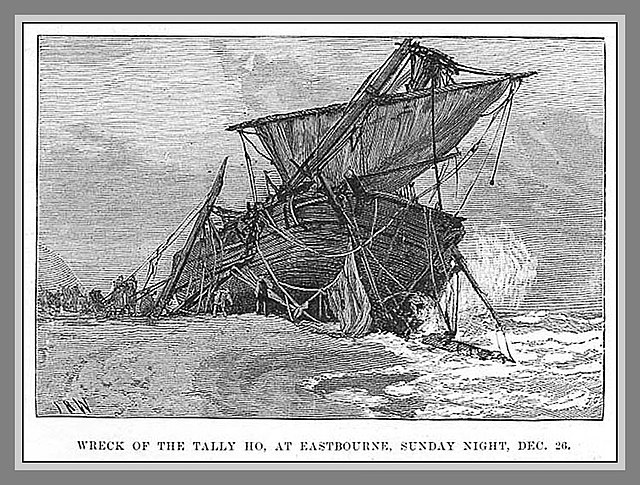
The first two stanzas describe a tragedy at sea caused by a ‘great storm’ where four people were saved but forty lost – ‘gone down together – / Into the boiling Sand –’. The lines ring out with dactyls (DA da da) followed by trochees (DA da). Tennyson famously used similar meter in his famous 1854 ballad “The Charge of the Light Brigade”. In Tennyson’s poem the dactylic rhythm suggests the galloping of the horses as they ride to the hell of battle. In Dickinson’s it is the punishing winds and waves that doom the ship and most of its passengers.

 Wreck of the Tally Ho, Josiah Robert Wells, 1887
The third stanza leaves the great storm behind and imagines stormy nights where the survivors or other Tellers describe the tragedy, the children frightened and concerned about the lost Forty. The transition in this stanza from event to the telling of it, is mirrored by Dickinson’s transitions from the forceful dactyl/trochee meter (“How they will tell the Story”) to gentler iambs and anapests – anapests being the opposite of dactyls (da da DA) and ending with plaintive iambs: “Did they – come back no more?”. 

The final stanza’s lines softly rock like the quieted sea in their use of anapest followed by iambs. The whole stanza is sibilant with ‘s’ sounds: The children are silenced, the Teller softened, and the only the Sea replies. And yet, despite its swishing murmurs and rolling crashes, the Sea reveals nothing. 

To live by the sea is to know the Glee (and what an amazing word to start the poem) but also the drowned, the tolling bells. The children soon learn to offer “no further question”.


Here are a few narrative ballads that Dickinson would probably have been familiar with:

The Sands of Dee’, Charles Kingsley, 1850

The Rime of the Ancient Mariner (1834) Samuel Taylor Coleridge

Paul Revere’s Ride, (1860) Henry Wadsworth Longfellow

The Lady of Shalott, (1842) Alfred, Lord Tennyson


08 September 2022

Sweet – safe – Houses –

 Sweet — safe — Houses —
Glad — gay — Houses —
Sealed so stately tight —
Lids of Steel — on Lids of Marble —
Locking Bare feet out —

Brooks of Plush — in Banks of Satin
Not so softly fall
As the laughter — and the whisper —
From their People Pearl —

No Bald Death — affront their Parlors —
No Bold Sickness come
To deface their Stately Treasures —
Anguish — and the Tomb —

Hum by — in Muffled Coaches —
Lest they — wonder Why —
Any — for the Press of Smiling —
Interrupt — to die —

Fr684 (1863)  J457


Dickinson’s family home might well be considered one of the houses described by this poem: ‘safe’ and ‘Sealed’; quiet and luxurious; and undisturbed by Death, Sickness, Anguish, and the barefoot poor. Ironically, the houses, a metonymy for the wealthy inhabitants, might be ‘safe’, but that includes being safe from the human condition. 

They might be Sweet and Glad and gay, but that requires being sealed off from all unpleasantness. Their laughter might be softer than “Brooks of Plush – in Banks of Satin”, but they live in an oyster’s world – as “People Pearl”. They really don’t know life at all. (‘Pearl’ should probably be read as ‘Purl’: According to the ED Lexicon and other sources, ‘Purl’ means ‘to flow with a murmuring sound’. I hate to lose the image, though, of the oyster shell which, for pearls, really is Plush and Satiny. I suspect Dickinson wanted both meanings: both Pearl and Purl.)

Of course, no house, and particularly one that housed Emily Dickinson is going to be entirely sealed or safe. Nor would it be free of anguish and death, but that’s not for want of trying

from Aftering website
Victorian metal grave covers
I like to read ‘Houses’ here as caskets. Fancier and much more expensive than the simple wooden coffin, steel caskets were introduced in the 1840s. Their ‘Lids of Steel’ were designed to permanently seal in the corpse – whose [eye]Lids of Marble” are equally sealed shut.

It’s easy to switch focus back and forth throughout the poem: rich houses, luxurious caskets, nice neighborhood, quiet necropolis. Both exclusive. No Shoes No Service. There is an important difference between the two milieus, however. While the rich are warding off exposure to and admittance of suffering and death, the dead are really dead. They couldn’t step outside their cushy oyster even if they wanted to. On the bright side, they no longer need to worry about Death entering their Parlors or even any ‘Bold Sickness’. 

The poem starts to get a bit difficult in the last line of the third stanza. I track the rest of the poem this way: ‘Anguish – and the Tomb –‘ begins a new sentence (although preceded by a dash and not a period) and is a compound subject for ‘Hum by – in Muffled Coaches’. So you have Muffled Coaches with their grim occupants humming by the houses or caskets of the well-to-do (the poor were buried in simple winding cloth or else in a simple wooden coffin). 

Why are the Coaches muffled? So that the Sweet, safe, Glad, gay Houses do not have to wonder at life being interrupted by death – or rather, why someone in a gay and smiling house party would interrupt the festivities to die. It is a bit difficult to parse this if the ‘they’ is the casket denizens rather than the wealthy in their Houses, but I take the muffling of noise as a courtesy to the dead who are softly whispering and laughing. They, too, ironically, would not appreciate the interruption.

Are ‘Houses’ meant to be seen as caskets? Would Emily Dickinson have pictured life in an important Victorian house as so restricted? I think she did, although, in another irony, she came to embrace the comfortable privacy of a stately but sealed house. And I picture her at the little desk in her room, listening to the ghostly Purl. 

Poetically, the poem has a lot of energy. The initial spondees (two accented syllables) followed by a third accented syllable (in ‘Houses’) and coupled with the alliterations in Sweet / Safe and Glad / Gay give a sprightly emphasis to the first stanza. There are then the tumble-forward trochaic feet (first syllable accented) that dominate the rest of the poem. Dickinson uses a quite a bit of alliteration and this provides a lightness to balance the rather serious social commentary. Even ‘Death’ is softened by ‘Bald’ and Sickness by ‘Bold’. No gruesome or pitying images here.

The poem maintains this balance between a happy meter adorned with charming alliteration until the last five lines. ‘Anguish’ is coupled with ‘the Tomb’, the harsh word signaling a change of mood. And although they ‘Hum’ by, Muffled, they bring the reader up short with the biggest interruption to a soiree possible: dying. It seems a bummer to both the living and the already dead.


02 September 2022

At leisure is the Soul

At leisure is the Soul
That gets a Staggering Blow—
The Width of Life—before it spreads
Without a thing to do—

It begs you give it Work—
But just the placing Pins—
Or humblest Patchwork—Children do—
To still it’s noisy Hands—                  [To] Help its Vacant Hands –

Fr683  (J618)


I find this poem sad and acutely observant.  Dickinson sketches a young person who, before their life has a chance to develop, suffers a ‘Staggering Blow’. It might have been a death, disaster, disease, or some other devastation. Dickinson limns its extent as ‘The Width of Life’. There is no getting around it, no getting past it. Instead of spreading out, gaining vantage and perspective, gathering experience and skill, the staggered Soul spreads out thinly ‘Without a thing to do –‘.  Life stretches out, barren in its reaches. Any work the person, the Soul, might have undertaken is lost. There is nothing it is called to do.

Simple patchwork quilt
Janet Wickell at The Spruce
Yet the sufferer wants something to fill the time, some sort of Work.  Nothing, however, that demands commitment, creativity, or even much effort. What is wanted is the sort of simple work and projects that a child can do. Dickinson gives two examples, both having to do with sewing: placing pins so hems and seams are held in place while sewing and making simple patchwork quilts. The goal is not the sewing but the quieting of the sufferer’s ‘noisy Hands’. 

It’s easy to picture the stunted soul picking at things, rubbing their hands, drumming mindlessly – actions that must soothe, somehow, the deep wounds. Dickinson wrote an alternate phrase: instead of ‘To still it’s noisy Hands –‘, there is ‘To Help its vacant Hands’ –‘.  Both phrases are poignant – and sad.  One seeks to quiet the busy hands, the other to stir the Vacant hands to some sort of activity.

The contrast in word/phrase structure between ‘a Staggering Blow’ and ‘The Width of Life’ is remarkable. The anapestic ‘Staggering’ sounds staggering, especially followed by the strong blow of ‘Blow’. ‘The Width of Life’ follows directly after, and the slow lilt of its iambic syllables grant a terrible spaciousness to the ‘leisure’ that lies ahead.


The first stanza is powerful and concise, containing the ravage of trauma to a spreading soul, with the resulting (and ironic) lifelong ‘leisure’.  The second stanza has the sketch: we see an adult working mindlessly, killing time, distracting their hands with the simplest of tasks. The Hands, however, are more here than work-doers – Dickinson’s poetic subject is ‘the Soul’ and the Hands are the Soul’s hands. It is the Soul begging for work, the Soul whose hands are noisy or, worse, vacant.

Dickinson writes here in a type of hymn meter styled ‘short’: each stanza has three lines with six syllables and one line, the third, with eight. That’s not a lot of syllables in which to pack so much meaning.

Rhyme and alliteration help achieve the poem’s tight weave where nothing should be added and nothing can be removed. Soul, Blow, and do (used twice) give us ‘o’ sounds that lengthen word and  meaning. The first stanza uses Soul, Staggering, and Spreads to use the soft ‘s’ sound to deliver the ‘Blow’. The ‘w’ sounds in Width, Without, and Work almost whisper their meaning, Irony is woven into the very sound of the poem.