Search This Blog

13 November 2015

God is a distant — stately Lover —

God is a distant — stately Lover —
Woos, as He states us — by His Son —
Verily, a Vicarious Courtship —
"Miles", and "Priscilla", were such an One —

But, lest the Soul — like fair "Priscilla"
Choose the Envoy — and spurn the Groom —
Vouches, with hyperbolic archness —
"Miles", and "John Alden" were Synonyme —
                                                                               F615 (1863)  J357

Although when this droll poem was published (in 1891, among the first) it was met with such outrage it was withdrawn. Impish as it is, however, I find the poem sweetly religious. God may be "distant" and "stately", but he loves humanity enough to woo. A less loving god would probably just drown the lot and start over. Oh, wait … Still, Dickinson's use of the Miles Standish legend to frame the Christian God's outreach to his fallen people is not only clever but apt.

Dickinson draws from Longfellow's The Courtship of Miles Standish, 1858. The Puritan captain loves Priscilla but feels he would botch the wooing, so instead he sends the young, handsome and silver-tongued John Alden to plead his case. What could go wrong? Here is Longfellow:

     Go to the damsel Priscilla, the loveliest maiden of Plymouth,
     Say that a blunt old Captain, a man not of words but of actions,
     Offers his hand and his heart, the hand and heart of a soldier.
     Not in these words, you know, but this in short is my meaning;
     I am a maker of war, and not a maker of phrases,
     You, who are bred as a scholar, can say it in elegant language,
     Such as you read in your books of the pleadings and wooings of lovers,
     Such as you think best adapted to win the heart of a maiden. (lines 148 – 155)

Unsurprisingly, the fair Priscilla chooses Alden and the two marry, leaving the poor Captain to his war making. 
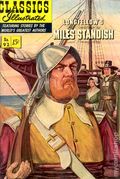
Standish does look a bit
warlike.

The Christian analog is the Old Testament God of the Jews who seeks the salvation of all people through the human incarnation of his son – who is the second part of the mystical Trinity of three beings (Father, Son, Holy Spirit) in one. No doubt he realizes the blunt old God of conquest and laws wouldn't appeal as much to the more settled, trade-based populations that emerged from tribal peoples. And so, Jesus.
        Dickinson makes no mention of redemption – the idea that Jesus is the ultimate blood sacrifice for human sins – but drolly suggests that the Son of God is simply a more appealing stand-in for the top of the Trinity ticket – the "stately Lover" himself. How clever: you think you spurned the Old Testament God of laws and retribution for the violence-abhorring Peace and Love Son – only to be informed later "with hyperbolic archness" that they are one and the same. Pwned.

That "hyperbolic archness" is one of many bits of word play and clever poetic devices. A hyperbola is itself an arch (or, technically, arc). Dickinson's depiction of God as a "stately Lover" who "states" conveys his distance and oldness – and lack of verbal facility (he is blunt, like Captain Standish). Dickinson's insertion of "Verily", a word the King James translators kept putting in Jesus' mouth to introduce the homely but effective parables, not only archly appropriates biblical language but merrily sets up the 'V' alliterations of Verily, Vicarious, and Vouches. Pure Dickinson fun!

For all the fun, despite the lack of reference to sin, salvation, damnation, or crucifixion, Dickinson clearly conveys the idea that God loves humanity. He woos intently; people don't have to beg for divine clemency, let alone love. Her contemporary audience, and even most English-speaking peoples today, would be familiar with the other concepts.

In other poems Dickinson depicts her mixed feelings about God the Father:

  • A fiercesome opponent: "He fumbles at your Soul" (F477) where God "fumbles at your Soul" and then "Deals One – imperial Thunderbolt"
  • An unfair judge: "It always felt to me – a wrong" (F521) where Dickinson feels that God's refusal to allow Moses enter Canaan
  • An ambiguous presence who "grows above" but cannot be seen: "My period had come for Prayer" (F525)
  • An uncaring deity: "Of Course – I prayed" (F581) where God cares so little for prayer that the poet says she would have been better off if God had never created her
  • A dangerous ambusher: I know that He exists" (F365) where should God decide to show himself, it is likely in jest and likely to be deadly.
  • The maestro of the natural world: "Like Mighty Foot Lights – burned the Red" (F507) where a glorious sunset is a divine production
  • An all-consuming master: "He put the Belt around my Life" (F330) where God has taken up the poet's life as if it were a deed of property
  • A cruel miser: "Victory comes late" (F195) where God's table is set too high for humanity so that they cannot eat all the goodies


There are more – the list is just what I came up with in a search through this site for "God". In general, Dickinson treats Jesus more tenderly and with more love and longing (if not, at times, passion) This poem bridges the dichotomy of Envoy versus the Groom. Unlike Priscilla who could only get one husband, you might choose the son but that old fox of a father comes along with him. 

12 November 2015

'Twas warm — at first — like Us —

'Twas warm — at first — like Us —
Until there crept upon
A Chill — like frost upon a Glass —
Till all the scene — be gone.

The Forehead copied stone —
The Fingers grew too cold
To ache — and like a Skater's Brook —
The busy eyes — congealed —

It straightened — that was all —
It crowded Cold to Cold —
It multiplied indifference —
As Pride were all it could —

And even when with Cords —
'Twas lowered, like a Weight —
It made no Signal, nor demurred,
But dropped like Adamant.
                                        F614 (1863)  J519

In a series of frosty similes, Dickinson depicts the transformation of a living body into a corpse. At the end, however, disposed of like a block of stone, it achieves a certain cold pride.

The poem begins with "'Twas', and by this "it" we understand the speaker is referring to a corpse. That ultimate transition, from a he or she to an it, begins subtly. The body is still warm – "like Us", but a "Chill" begins to creep over it, as if cold were a living thing. Dickinson likens it to frost creeping over a window and erasing the scenery it once framed. Just so, the Chill erases the thoughts and memories and even the facial expressions that give each life its particular prospect. First, the forehead becomes rigid, then the hands, and finally the "busy eyes" which congeal into the opaqueness of ice on water.
        After death the body stiffens, the Chill becoming a pervading hard cold. But then it "multiplied indifference – / As Pride were all it could". The entire body, now in rigor mortis, exudes indifference to air, to people, to its lost life and to its impending fate. It cannot fend for itself and must be manhandled into grave clothes, into the coffin (if there was even a coffin), and finally into the earth. Its stiff, silent acquiescence in its own burial is, I think, what Dickinson suggests as pride. Having given an almost clinical depiction of the death process, she grants the corpse this dignity at the moment of its greatest indignity. It "made no Signal, nor demurred". It reminds me of the person about to be hanged or beheaded who stands straight and tall and silent, and about whom it is said, "He died well."

Unlike scenes in some of her earlier poems about death, no King appears; no one holds wine to the sufferer's mouth and whispers about the glorious kingdom to come. She has stripped the transition from life to death of all sentiment and religious comfort. Yet she takes the lifeless body's cold immobility and imaginatively grants its silence agency as it drops like "Adamant".
        Dickinson typically uses "Adamant" to mean something stony and hard (such as Samuel Bowles' heart in"Just Once! Oh least Request!" (F478where she calls him the "God of Flint"). 'Adamant' is a perfect word to end the poem. The cold weight of the word itself cuts the poem off as dramatically as if it, too dropped into the abyss.
        Still another meaning of "adamant" lingers in the shadow of the poem's end. To be adamant is to be inflexible, rigid, and unyielding, and this poem offers no hint of repentance – nor of grace. It is a proud, bleak, cold-eyed work.


You can see Dickinson's mastery of word sounds mirroring meaning throughout the poem. The first line, about warmth, has the warm sounds of 'w' and 'Us'. The cold, hard sounds (hard 'c', 'b', 'd') begin in the second stanza, culminating in "It crowded Cold to Cold". The following line, "It multiplied indifference" is not only a dramatic contrast in its multi-syllabic airiness, but introduces the 'd' sounds that ballast the last two lines.
        Looking at the word 'Adamant' yet again, not only does the hard 'd' mirror the proud, hard corpse, but the last two syllables are unaccented. The word hits hard and dwindles just as the corpse hits the bottom of the grave only to be muffled by sod.

02 November 2015

The Day that I was crowned

The Day that I was crowned
Was like the other Days —
Until the Coronation came —
And then — 'twas Otherwise —

As Carbon in the Coal
And Carbon in the Gem
Are One — and yet the former
Were dull for Diadem —

I rose, and all was plain —
But when the Day declined
Myself and It, in Majesty
Were equally — adorned —

The Grace that I — was chose —
To Me — surpassed the Crown
That was the Witness for the Grace —
'Twas even that 'twas Mine —
                            Fr613 (1863)  J356

While Scholar Barton Levi St. Armand thinks the poem is about the sun, I think it is about grace. Dickinson says as much in the final stanza. She was chosen by Grace, a concept rooted in Calvinism. In this branch of Christianity, very influential in Dickinson's time and place, only some people were elected for heaven. It was a heavenly favor, a grace rather than something earned. To suddenly be sure of your divine election would surely feel like a coronation; the knowledge would blaze like a glorious sunset.

Dickinson opens the poem in story-telling mode. The day that she was crowned began ordinarily enough. "All was plain". But somehow by day's end she was "adorned" in "Majesty", as transfigured as diamond from coal.

In regards to this, Sewall provides an illuminating excerpt (p.452-54) from one of Charles Wadsworth's sermons: "The value of a gem is not in its composition, but in its crystallization. Even the diamond is composed mainly of carbon, and differs from the black coal of our furnaces only in this transfiguration … But the spiritual man has through gracious crystallization become a gem, reflecting Divine light, and thus fitted for a diadem" (found in Richard Brandley's Emily Dickinson's Rich Conversation: Poetry, Phiulosophy, Science").
As Wadsworth points out, a "gracious crystallization" makes the redeemed soul fit for a crown. Dickinson was a great admirer of Wadsworth and read his sermons. And although this poem seems to emerge from the sermon, it is not entirely clear as to whether her crystallization was spiritual or imaginary, or whether she was using religious language to celebrate some other great transformation. Dickinson remains purposefully vague and ambiguous. There is no mention of heaven or God or Atman – or even the soul.

In the second two stanzas Dickinson leaves the carbon metaphor to end with a sunset analogy. The setting sun is adorned in majesty, its colors flaring across the heavens. The poem's speaker says that its glory was equal to her own. Ultimately, however, she deems the grace of being chosen as superior to the simpler adornment of the sun, the sky's crown. Dickinson even co-opts the sun, not only as a witness for her ascendency, but as dower. Sunset becomes hers: "'Twas even that 'twas Mine".
This vast claiming reminds me of Dickinson's proclamation in "I'm ceded – I've stopped being Theirs" (F353) where she says her childhood baptism was just something "They" did to her, but now she has "consciously, of Grace" been "Called to my Full", her "Existence's whole Arc, filled up". Both poems inhabit the liminal region where grace may be found or claimed or bestowed. Sometimes Dickinson claims the grace, as in "I'm Ceded"; sometimes she discovers it, as in this poem where she finds she is "chose". 

26 July 2015

'Tis Opposites — Entice —

'Tis Opposites — Entice —
Deformed Men — ponder Grace —
Bright fires — the Blanketless —
The Lost — Day's face —

The Blind — esteem it be
Enough Estate — to see —
The Captive — strangles new —
For deeming — Beggars — play —

To lack — enamor Thee —
Tho' the Divinity —
Be only
Me —

                                                     F612 (1863)  J355
  

Ruth Miller in The Poetry of Emily Dickinson has helpfully organized lists of the poems according to topic (a great resource I just discovered!). This poem falls into "Poems Rendering Compensation (Yoked Opposites)", along with forty three others including
-       "A Wounded Deer – leaps highest" (Fr180, J165)
-       "To learn the Transport by the Pain" (Fr178, J167)
-       "Water is taught by thirst" (Fr93, J135)
-       "The Zeroes – taught us – Phosphorus" (Fr284, J689)
-       "I can wade Grief" (Fr312, J252)
-       "'Tis so appalling – it exhilarates" (Fr341, J281)
-       "We lose – because we win" (Fr28, J21)
-       "Success is counted sweetest" (Fr112, J67)
-       "For each extatic instant" (Fr109, J125)
-       "Sunset at Night – is natural" (Fr427, J415)


Here, Dickinson seems to be writing a clever and somewhat tongue-in-cheek appeal for love. She begins by listing some fairly conventional opposites: a state of deprivation is linked to a desired state of greater fulfilment – that which seems opposite to the current, unfortunate state.

Beggar Children
Johann Georg Meyer von Bremen (1813-1886)
To those with physical constraints, it is grace or gracefulness; to the homeless, the warmth of a fire; to those lost or lonely, the clarifying and uplifting light of day; to the blind, seeing. The seventh and eighth lines are more difficult, but I think they might be paraphrased as "the captive will risk further oppression for the chance to dream and choose; the beggar wishes the luxury of play."
            The last stanza begins in keeping with the list of opposites, but as an address to someone. On first reading, the "Thee" might seem to be a universal "You", but as the poems funnels visually down to "Me", we realize that the speaker's remarks are aimed at a very particular "Thee". If you find yourself lacking or incomplete, she says, become enraptured, even if the "Divinity" you focus on is "only / Me".  It's a droll way to invite a romance.


Dickinson uses quite a bit of simple rhyme to add lightness to the poem. The first stanza has Entice, Grace, and face. The second and third stanzas all are based on "ee" rhymes: be, see, play, Thee, Divinity, only, and Me.

15 July 2015

Her sweet Weight on my Heart a Night

Her sweet Weight on my Heart a Night
Had scarcely deigned to lie —
When, stirring, for Belief's delight,
My Bride had slipped away —

If 'twas a Dream — made solid — just
The Heaven to confirm —
Or if Myself were dreamed of Her —
The power to presume —

With Him remain — who unto Me —
Gave — even as to All —
A Fiction superseding Faith —
By so much — as 'twas real —
                                                            F611 (1863)  J518

The narrator suspects the bliss of sleeping with her beloved happened in a dream. She takes the disappearance of her "Bride" philosophically, however, for she has the God-given gift of making dreams seem as real as if they had truly happened. And who needs the complications of reality if dreaming makes it so?
            The nighttime experience raises the usual philosophical questions: how can we tell dream from reality? Could the dream have been enfolded in another's dream – in this case, was the narrator experiencing her beloved's dream?

            Dickinson resorts to God: he is the only one who can "confirm" what really happened. But in addition to being all-knowing, God gives the narrator / Dickinson / all of us the ability to experience "Fiction" so vividly as to seem real. This hyper-real Fiction supersedes Faith.
The Dickinson Lexicon defines "Faith" in this line as "Knowledge; sentiment based on concrete evidence" and this makes a commonsense reading: the imaginative world is potentially more real than the knowledge-based. In this case, the dream creation was more "solid" than the empty bed.
I take that last stanza as Dickinson broadly accounting for her powerful poetic imagination. Whether it is a lover, an Abyss, or death, she experiences it as truly – more truly – than a 'real' experience. Dickinson does concede that God gives this ability "to All", but this strikes me as an afterthought.
I am reminded of of Marianne Moore's famous "Ars Poetica" in which she writes that good poetry should have "imaginary gardens with real toads in them".  That is the landscape Dickinson inhabited, too.


Judith Farr argues convincingly that the poem is written with Sue in mind. In The Passion of Emily Dickinson, she has this to say: ""When Lavinia first gave [Sue] Emily's manuscripts, Sue marked them in pencil according to theme: Love, Nature, Death, and so on. She marked this poem with the initial 'S', appearing to acknowledge its relevancy to herself" (p.160).
            I don't think a biographical interpretation adds much to the poem, however. Certainly Dickinson spent no effort on fleshing out the beloved. She is just an exemplar of the poem's greater point about Fiction vs. Faith.


05 July 2015

From Cocoon forth a Butterfly

From Cocoon forth a Butterfly
As Lady from her Door
Emerged — a Summer Afternoon —
Repairing Everywhere —

Without Design — that I could trace
Except to stray abroad
On miscellaneous Enterprise
The Clovers — understood —

Her pretty Parasol be seen
Contracting in a Field
Where Men made Hay —
Then struggling hard
With an opposing Cloud —

Where Parties — Phantom as Herself —
To Nowhere — seemed to go
In purposeless Circumference —
As 'twere a Tropic Show —

And notwithstanding Bee — that worked —
And Flower — that zealous blew —
This Audience of Idleness
Disdained them, from the Sky —

Till Sundown crept — a steady Tide —
And Men that made the Hay —
And Afternoon — and Butterfly —
Extinguished — in the Sea —

                                                                         F610 (F610)  J354

This lovely poem recalls Solomon's wisdom in the Biblical book Ecclesiastes: both the verse about eating, drinking, and being merry; as well as that about dust to dust. There is also a hint of Aesop's fable praising the hard-working ant in contrast to the pleasure-loving musical cricket.
            The poem begins as the butterfly, metaphorically compared to a Lady, emerges on a summer afternoon and begins flitting about without discernable purpose or pattern. While the narrator dismisses this activity as some "miscellaneous Enterprise", the wiser "Clovers – understood". It is pollinators such as butterflies, after all, that ensure clovers' continued presence in the meadow.
As the butterfly feeds and suns, wings upright, Dickinson zooms out so that we see laborers mowing the meadow. It's hard work, and Dickinson immediately and comically contrasts it with the butterfly "struggling hard" against an "opposing Cloud" to join other butterflies wheeling about. They are "Phantom", their destination "Nowhere", their flight patterns "purposeless". It seems to the narrator that they are just showing off their lovely colors and grace.
The Clover knows ...
            So far the poem seems as much commentary on ladies as it does on butterflies. Both groups of wandering idlers disdainfully watch the working population – here laborers, bees, and flowers (whose work is unclear, but who are tethered to the ground and must bow and blow with every puff of wind). But in the last stanza Dickinson reminds us that all are destined for oblivion. Converting the sky to sea (as she has in several previous poems), the approach of night becomes a relentless Tide that carries all in its path to the sea where they are "Extinguished". It is not just the haymakers and butterflies that are swallowed up, but time as well. The afternoon is extinguished by night as surely as the laborer and the idler.
            This last stanza forces us to re-think the rest of the poem. When darkness drowns the light, when life and time are over, what does it matter if we have laid up hay or honey, or been prudent like Aesop's hard-working ants; or, like lady and butterfly, flitted about, conducting miscellaneous Enterprise in the finery of our prime? (And I suspect Dickinson appreciated the ecological role of both butterfly and lady in their respective niches.)  "Vanity of vanities; all is vanity," writes Solomon in Ecclesiastes (12:8, King James Bible). "All things come alike to all: there is one event to the righteous, and to the wicked…" (9:2). "There is nothing better for a man", Solomon concludes, than that he should eat and drink, and that he should make his soul enjoy good in his labour (2:24).

Dickinson writes the poem in a quiet, observational tone. There are sixteen words of at least three syllables and this lends the poem a rather stately pace. They lead up to "Extinguished" in the final line, – a rich, iambic word that quietly puts to eternal bed the butterfly emerging from cocoon in the first line. Dickinson as observer can find "no Design" in the butterfly's movements that day, but as she contrasts it with the quotidian work going on in the meadow we see both as emblematic of a lovely and ephemeral summer's day.