Search This Blog

30 January 2024

Dear Readers

It’s no secret that I’ve been exceedingly slow to post new prowling Bee content over the past few years. This dereliction is not due to loss of interest, personal tragedies, or an exciting new career. May I suggest, Reader, that after 685 poems I’m just … ready to be a responder rather than a composer? 


The Prowling Bee was born in 2011 – twelve and a half years ago. Despite having loved Dickinson poems since grade school and taught Dickinson in community college classes, I’d barely begun making my way through the Franklin Reading Edition. My older collections didn’t include the most passionate, difficult, or challenging poems so I was flabbergasted almost daily. When my excitement, wonder, and marginalia started getting out of hand, I began composing my thoughts at the computer rather than the easy chair. This was the beginning of the blog. When I read the wonderful poem ‘Bloom – is Result – to meet a Flower’ (Fr1038) where I encountered ‘the prowling Bee’, I knew that’s what I wanted. To be the Bee.


The Flower, Dickinson writes, must try to ‘escape the prowling Bee’ – it’s part of a flower’s ‘profound / Responsibility’. I take this as the poet’s challenge. Her poems are often elusive, ambiguous and enigmatic. Take the Bloom poem: why should the flower be concerned about a bee?  Any bee worth the honey prowls about the flowers.  In fact, Dickinson writes in an earlier poem (Fr235), ‘The Flower must not blame the Bee – / That seeketh his felicity / too often at her door–’.  


So the Flower is a bit of a tease. But the Bee is up for it. I may be bowing out of the commentaries, but the Bee will prowl on. 

(bit of a drum roll here)

Reader, there is a new Bee! Adam DeGraff! He will be introducing himself in the next post, but many of you have already encountered him in the Comments where he posted under the moniker ‘d Scribe’.  For some years I’ve looked forward to his responses – they are unfailingly insightful and interesting. He addresses the heart as well as the logistics of the poems.  He clearly – and most importantly -- loves Dickinson’s work. I’ve been enriched by his commentary and am thrilled and grateful that he is donning the bee-ish mantle.

Please welcome Adam to the fascinating dance of Bee and Bloom and may he ‘seeketh his felicity’ at the flower’s door for at least a thousand more poems.

As a final note:
Poetry lovers from all walks of life and from all over the world read the Bee. As of today there have been 3.5 million page views and 5077 comments on the 685 poems. Although many of the comments are from readers expressing their appreciation for the Bee project, most are responding to the poems. These comments are the heart of the Bee. They range from discussions of meaning to analysis of poetic forms and techniques to musings about Dickinson herself. Sometimes they grapple with the poems and sometimes they add contextual and biographical information. Some long-time and frequent posters have become part of the Bee family. To you, I give special thanks. I feel we go hand in hand forward. I know Adam feels the same way.


01 May 2023

Glee—The great storm is over—

Glee—The great storm is over—
Four—have recovered the Land—
Forty—gone down together—
Into the boiling Sand—

Ring—for the scant Salvation—
Toll—for the bonnie Souls—
Neighbor—and friend—and Bridegroom—
Spinning opon the Shoals—

How they will tell the Story—
When Winter shake the Door—
Till the Children urge—                         [Children ask]
But the Forty—
Did they—come back no more?

Then a silence—suffuse the story—
And a softness—the Teller's eye—
And the Children—no further question—
And only the Sea—reply—
                                                Fr685 (1863)  J619


I picture Dickinson performing this rollicking ballad to an intimate audience that included children. I vaguely remember from long ago studies that poetry readings were fairly popular Victorian entertainments, and that would be particularly true in educated communities such as Amherst.  

This ballad, however, does more than tell a tale: it goes on to describe a setting for and the anticipated response to the tale telling. As the perspective changes, so does the tone – and meter here drives the tone. A bit of scansion reveals how.

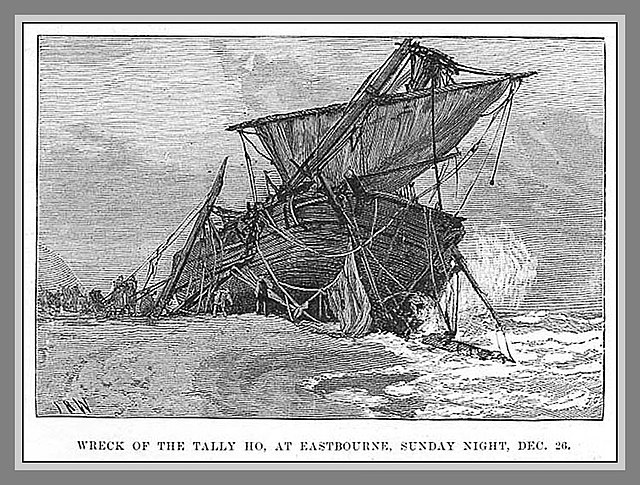
The first two stanzas describe a tragedy at sea caused by a ‘great storm’ where four people were saved but forty lost – ‘gone down together – / Into the boiling Sand –’. The lines ring out with dactyls (DA da da) followed by trochees (DA da). Tennyson famously used similar meter in his famous 1854 ballad “The Charge of the Light Brigade”. In Tennyson’s poem the dactylic rhythm suggests the galloping of the horses as they ride to the hell of battle. In Dickinson’s it is the punishing winds and waves that doom the ship and most of its passengers.

 Wreck of the Tally Ho, Josiah Robert Wells, 1887
The third stanza leaves the great storm behind and imagines stormy nights where the survivors or other Tellers describe the tragedy, the children frightened and concerned about the lost Forty. The transition in this stanza from event to the telling of it, is mirrored by Dickinson’s transitions from the forceful dactyl/trochee meter (“How they will tell the Story”) to gentler iambs and anapests – anapests being the opposite of dactyls (da da DA) and ending with plaintive iambs: “Did they – come back no more?”. 

The final stanza’s lines softly rock like the quieted sea in their use of anapest followed by iambs. The whole stanza is sibilant with ‘s’ sounds: The children are silenced, the Teller softened, and the only the Sea replies. And yet, despite its swishing murmurs and rolling crashes, the Sea reveals nothing. 

To live by the sea is to know the Glee (and what an amazing word to start the poem) but also the drowned, the tolling bells. The children soon learn to offer “no further question”.


Here are a few narrative ballads that Dickinson would probably have been familiar with:

The Sands of Dee’, Charles Kingsley, 1850

The Rime of the Ancient Mariner (1834) Samuel Taylor Coleridge

Paul Revere’s Ride, (1860) Henry Wadsworth Longfellow

The Lady of Shalott, (1842) Alfred, Lord Tennyson


08 September 2022

Sweet – safe – Houses –

 Sweet — safe — Houses —
Glad — gay — Houses —
Sealed so stately tight —
Lids of Steel — on Lids of Marble —
Locking Bare feet out —

Brooks of Plush — in Banks of Satin
Not so softly fall
As the laughter — and the whisper —
From their People Pearl —

No Bald Death — affront their Parlors —
No Bold Sickness come
To deface their Stately Treasures —
Anguish — and the Tomb —

Hum by — in Muffled Coaches —
Lest they — wonder Why —
Any — for the Press of Smiling —
Interrupt — to die —

Fr684 (1863)  J457


Dickinson’s family home might well be considered one of the houses described by this poem: ‘safe’ and ‘Sealed’; quiet and luxurious; and undisturbed by Death, Sickness, Anguish, and the barefoot poor. Ironically, the houses, a metonymy for the wealthy inhabitants, might be ‘safe’, but that includes being safe from the human condition. 

They might be Sweet and Glad and gay, but that requires being sealed off from all unpleasantness. Their laughter might be softer than “Brooks of Plush – in Banks of Satin”, but they live in an oyster’s world – as “People Pearl”. They really don’t know life at all. (‘Pearl’ should probably be read as ‘Purl’: According to the ED Lexicon and other sources, ‘Purl’ means ‘to flow with a murmuring sound’. I hate to lose the image, though, of the oyster shell which, for pearls, really is Plush and Satiny. I suspect Dickinson wanted both meanings: both Pearl and Purl.)

Of course, no house, and particularly one that housed Emily Dickinson is going to be entirely sealed or safe. Nor would it be free of anguish and death, but that’s not for want of trying

from Aftering website
Victorian metal grave covers
I like to read ‘Houses’ here as caskets. Fancier and much more expensive than the simple wooden coffin, steel caskets were introduced in the 1840s. Their ‘Lids of Steel’ were designed to permanently seal in the corpse – whose [eye]Lids of Marble” are equally sealed shut.

It’s easy to switch focus back and forth throughout the poem: rich houses, luxurious caskets, nice neighborhood, quiet necropolis. Both exclusive. No Shoes No Service. There is an important difference between the two milieus, however. While the rich are warding off exposure to and admittance of suffering and death, the dead are really dead. They couldn’t step outside their cushy oyster even if they wanted to. On the bright side, they no longer need to worry about Death entering their Parlors or even any ‘Bold Sickness’. 

The poem starts to get a bit difficult in the last line of the third stanza. I track the rest of the poem this way: ‘Anguish – and the Tomb –‘ begins a new sentence (although preceded by a dash and not a period) and is a compound subject for ‘Hum by – in Muffled Coaches’. So you have Muffled Coaches with their grim occupants humming by the houses or caskets of the well-to-do (the poor were buried in simple winding cloth or else in a simple wooden coffin). 

Why are the Coaches muffled? So that the Sweet, safe, Glad, gay Houses do not have to wonder at life being interrupted by death – or rather, why someone in a gay and smiling house party would interrupt the festivities to die. It is a bit difficult to parse this if the ‘they’ is the casket denizens rather than the wealthy in their Houses, but I take the muffling of noise as a courtesy to the dead who are softly whispering and laughing. They, too, ironically, would not appreciate the interruption.

Are ‘Houses’ meant to be seen as caskets? Would Emily Dickinson have pictured life in an important Victorian house as so restricted? I think she did, although, in another irony, she came to embrace the comfortable privacy of a stately but sealed house. And I picture her at the little desk in her room, listening to the ghostly Purl. 

Poetically, the poem has a lot of energy. The initial spondees (two accented syllables) followed by a third accented syllable (in ‘Houses’) and coupled with the alliterations in Sweet / Safe and Glad / Gay give a sprightly emphasis to the first stanza. There are then the tumble-forward trochaic feet (first syllable accented) that dominate the rest of the poem. Dickinson uses a quite a bit of alliteration and this provides a lightness to balance the rather serious social commentary. Even ‘Death’ is softened by ‘Bald’ and Sickness by ‘Bold’. No gruesome or pitying images here.

The poem maintains this balance between a happy meter adorned with charming alliteration until the last five lines. ‘Anguish’ is coupled with ‘the Tomb’, the harsh word signaling a change of mood. And although they ‘Hum’ by, Muffled, they bring the reader up short with the biggest interruption to a soiree possible: dying. It seems a bummer to both the living and the already dead.


02 September 2022

At leisure is the Soul

At leisure is the Soul
That gets a Staggering Blow—
The Width of Life—before it spreads
Without a thing to do—

It begs you give it Work—
But just the placing Pins—
Or humblest Patchwork—Children do—
To still it’s noisy Hands—                  [To] Help its Vacant Hands –

Fr683  (J618)


I find this poem sad and acutely observant.  Dickinson sketches a young person who, before their life has a chance to develop, suffers a ‘Staggering Blow’. It might have been a death, disaster, disease, or some other devastation. Dickinson limns its extent as ‘The Width of Life’. There is no getting around it, no getting past it. Instead of spreading out, gaining vantage and perspective, gathering experience and skill, the staggered Soul spreads out thinly ‘Without a thing to do –‘.  Life stretches out, barren in its reaches. Any work the person, the Soul, might have undertaken is lost. There is nothing it is called to do.

Simple patchwork quilt
Janet Wickell at The Spruce
Yet the sufferer wants something to fill the time, some sort of Work.  Nothing, however, that demands commitment, creativity, or even much effort. What is wanted is the sort of simple work and projects that a child can do. Dickinson gives two examples, both having to do with sewing: placing pins so hems and seams are held in place while sewing and making simple patchwork quilts. The goal is not the sewing but the quieting of the sufferer’s ‘noisy Hands’. 

It’s easy to picture the stunted soul picking at things, rubbing their hands, drumming mindlessly – actions that must soothe, somehow, the deep wounds. Dickinson wrote an alternate phrase: instead of ‘To still it’s noisy Hands –‘, there is ‘To Help its vacant Hands’ –‘.  Both phrases are poignant – and sad.  One seeks to quiet the busy hands, the other to stir the Vacant hands to some sort of activity.

The contrast in word/phrase structure between ‘a Staggering Blow’ and ‘The Width of Life’ is remarkable. The anapestic ‘Staggering’ sounds staggering, especially followed by the strong blow of ‘Blow’. ‘The Width of Life’ follows directly after, and the slow lilt of its iambic syllables grant a terrible spaciousness to the ‘leisure’ that lies ahead.


The first stanza is powerful and concise, containing the ravage of trauma to a spreading soul, with the resulting (and ironic) lifelong ‘leisure’.  The second stanza has the sketch: we see an adult working mindlessly, killing time, distracting their hands with the simplest of tasks. The Hands, however, are more here than work-doers – Dickinson’s poetic subject is ‘the Soul’ and the Hands are the Soul’s hands. It is the Soul begging for work, the Soul whose hands are noisy or, worse, vacant.

Dickinson writes here in a type of hymn meter styled ‘short’: each stanza has three lines with six syllables and one line, the third, with eight. That’s not a lot of syllables in which to pack so much meaning.

Rhyme and alliteration help achieve the poem’s tight weave where nothing should be added and nothing can be removed. Soul, Blow, and do (used twice) give us ‘o’ sounds that lengthen word and  meaning. The first stanza uses Soul, Staggering, and Spreads to use the soft ‘s’ sound to deliver the ‘Blow’. The ‘w’ sounds in Width, Without, and Work almost whisper their meaning, Irony is woven into the very sound of the poem.


05 August 2022

So well that I can live without –

 So well that I can live without –
I love thee – then How well is that?
As well as Jesus?
Prove it me
That He – loved Men –
As I – love thee –

                                            Fr682 (1863)  J456

This short love poem is intense – and pretty flippant. The speaker begins by declaring she loves her ‘thee’ so much that she can live without him. Her love stands on its own strength all on its own. Not for her the neediness of wanting to be by her beloved’s side, look into her eyes, stand together outside in the moonlight, exchange all the little signs and proofs that feed love. 

Could this be a poem to ‘Master’? I don’t think so. The Master letters are full of longing; they have a beseeching tone:

Could you come to New England – Would you come to Amherst – Would you like to come – Master? Would it do harm – yet we both fear God – Would Daisy disappoint you – no – she wouldn’t – Sir – it were comfort forever – just to look in your face, while you looked in mine – then I could play in the woods – till Dark – till you take me where sundown cannot find us – and the true keep coming ….” Letter 3, 1861

The letter (as far as we know, never sent – and we don’t really know who Master is, either) does have a bit of playfulness  and a bit of boldness. But Daisy (a nickname Emily at times uses to refer to herself) pleads with Master to come. She needs the comfort of looking in his face.

In contrast, the poem’s speaker is confident and challenging. ‘How well do I love you,’ she asks. ‘As well as Jesus?’ Flippant, yes? And then the challenge: “Prove it me / That He – loved Men – / As I – love thee –“. It’s a good challenge. Her love needs no feeding – it exists ‘without’, and I take that to mean without presence, without letters, without rings and lockets and other tokens. 

And what about Jesus? Can a case be made that he loved (the past tense Dickinson employs here is interesting) Men as much? 

It's different. The Christian New Testament presents Jesus a divine sacrifice: He dies so that humanity might be saved . But there are strings attached to the salvation part. You must be a Christian; you might also have to have been predestined for salvation (this was the Calvinist position Dickinson’s community would be familiar with and generally accept). The point is, there is a heaven for the appropriate believers and there is a hell for the rest. 

Well, it’s a comparison impossible to make between the speaker’s love and the love of Jesus for humanity. After all, she has to only love one person. Plus, it is near to impossible to prove a negative. But the rhetoric is strong and that carries the day. 
Susan Dickinson (from Wikipedia

Could the poem have been written with Sue in mind? Dickinson was becoming used to being ‘without’ her although Sue and Austin – Sue’s husband, Emily’s brother – lived just a hundred yards away. The two women, once passionately inseparable, became much more distant. There was the marriage and Sue’s adjusted role as Mrs. Dickinson; and there was the birth of little Ned in 1861. Some of Dickinson’s other poems point to differences and estrangements, but this poem goes all out for love with no strings attached and no encouragement needed.

25 July 2022

Don't put up my Thread & Needle

Don't put up my Thread & Needle –
I'll begin to Sow
When the Birds begin to whistle –
Better stitches – so –

These were bent – my sight got crooked –
When my mind – is plain
I'll do seams – a Queen's endeavor
Would not blush to own –

Hems – too fine for Lady's tracing
To the sightless Knot –
Tucks – of dainty interspersion –
Like a dotted Dot –

Leave  my Needle in the furrow –
Where I put it down –
I can make the zigzag stitches
Straight – when I am strong –

Till then – dreaming I am sewing
Fetch the seam I missed –
Closer – so I – at my sleeping –
Still surmise I stitch –
                                                
                                                Fr681 (1863)  J617


One thing Emily Dickinson is not remembered for is her sewing. She had, however, at least a passing interest in sewing. Naturally she would. Sewing was considered a basic female household skill, a way for womenfolk to benefit the poor, and at the least, a harmless social activity.
    During her younger years Dickinson was a member of Amherst's Sewing Society, both a benevolent and a social group. She was, however, not an enthusiastic member. We know this from a letter she wrote a girlhood friend when Dickinson was twenty:
The sewing Society has commenced again – and held its first meeting last week – now all the poor will be helped – the cold warmed – the warm cooled – the hungry fed – the thirsty attended to – the ragged clothes – and this suffering – tumbled down world will be helped to it's feet again – which will be quite pleasant to all. I dont attend – notwithstanding my high approbation – which must puzzle the public exceedingly. I am already set down as one of those brands almost consumed – and my hardheartedness gets me many prayers.

                        - Letter to Jane Humphrey, January, 1850 

Dickinson's tone in this letter is lighthearted, flippant, even. Her idea that she might be considered 'one of those brands almost consumed' reminds me of old folks shaking their heads at twenty-somethings and muttering, 'Live fast, die young.' While 'brand' can mean both a persona and a product identifier (and, at the time she wrote this, the mark inflicted on slaves – although I do not believe there is a shadow of that meaning in the poem), Dickinson uses its earliest meaning here: a piece of burning wood. She is amused that by avoiding the sewing society she is marked as a fast liver, a fire brand with not much stick left. But at least that assessment gets her many prayers.

Notwithstanding her expressed lack of interest, sewing is central to this poem. One can read it as the speaker's straightforward bit of instruction to a friend or family member to keep her sewing things handy until she has recovered enough from some unnamed ailment and can see better. This reading makes sense biographically. Within a year of writing the poem, Dickinson was spending months in Boston under an ophthalmologist's care. The doctor severely restricted her time outdoors, her reading, and her writing. Dickinson herself referred to this period as being in jail, or in Siberia. She was terrified of not being able to read again.
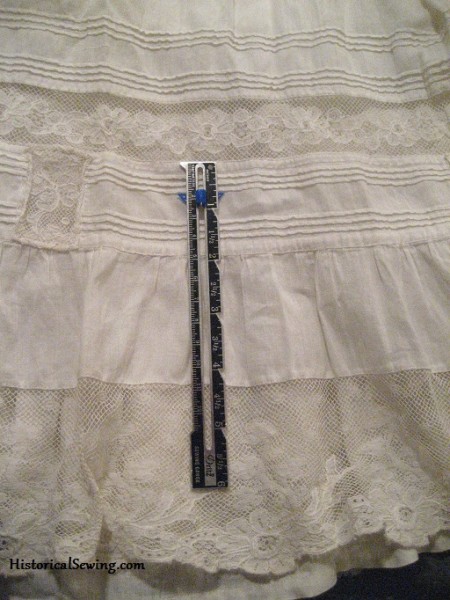
from Historical Sewing: https://historicalsewing.com/pintucks-the-old-fashioned-way
Example of pintucks:
from Historical Sewing
https://historicalsewing.com/
pintucks-the-old-fashioned-way


    But the terror isn't evident in this poem. The speaker begins optimistically: her sewing materials shouldn't be put away because she'll be using them again come spring – and with better results. In the second stanza she explains that her vision was 'crooked' but when her mind is 'plain', that is, clearer, she will be able to sew seams a Queen would be proud of. She goes on: her Hems will be so neatly done that they can't be seen, can't be traced back to their tiny and nearly invisible knots. The 'Tucks' she mentions are pintucks, which are narrow little folds sewn into place. Those stitches will be smaller than dots – 'Like a dotted Dot'.
    The speaker specifies that her sewing needle should be left in the seam where she put it down. Although her stitches had become 'zigzag', she claims she can make them straight again.
   The last stanza suggests a real passion for sewing in that the speaker wants a piece she was working on, one with a missed seam, placed near her while she sleeps so she can at least dream that she is sewing. This does not sound like Jane Humphrey's pen pal!

So let's read the poem a different way! But let's keep the vision crisis, the dim light, the restricted reading and writing.

It is hard to miss the 'Sow' in the first stanza that early editors 'corrected' to 'Sew'. But 'Sow' is important. The first stanza ends with 'so' as if to reinforce the word. Additionally, Dickinson makes reference to the agricultural 'Sow' in the fourth stanza where she specifies her needle should be left in the 'furrow' where she had put it down as if it were a hoe in between rows of radishes. Perhaps she wants her pencil left in the pages where she left off so she can work on any 'zigzag' lines when she once again has the vision and strength.
    How else might sewing and sowing be alike? Poetry is the link. Poetry stitches words, thoughts, and images together. A good poet, like Dickinson!, sews with straight sight, writes with strength, dreams of lines and images, longs to write. More literally, Dickinson physically stitched groupings of her poetry into little booklets we call 'fascicles'. Agriculturally, poetry sows and plants seeds; and tends and prunes words until the poem is shapely and bears fruit.
   The weaving together of sewing, sowing, and poetry seems almost effortless. The pain is there to be seen but it isn't powerfully felt. We wait for spring, we are confident, like the speaker, that she will pick up where she left off, that even while sleeping she is still dreaming. The poem itself is an answer to the question of return. We see ourselves that, yes, her hems are too fine for Lady's tracings.

The poem alternates trochaic tetrameter with trochaic trimeter – not the iambic meters Dickinson more typically uses. I'm also struck by all the important words that begin with 'S': Sow, stitches, so, seams, sightless, straight, strong, sleeping, surmise, stitch. In the last stanza there is an extra abundance of 's' sounds: sewing, seam, missed, closer, so, sleeping, still, surmise, stitch. I think it is the smoothness of the 's' sounds that help the poem glide over the difficult time Dickinson alludes to. There are only two harsh-sounding words in the poem: crooked and zigzag. Yet their harshness is in regards to the stitches rather than the hopes.


05 October 2021

Triumph – may be of several kinds –

Triumph – may be of several kinds – There’s Triumph in the Room When that Old Imperator – Death – By Faith – be overcome –

There’s Triumph of the finer mind

When Truth – affronted long –

Advance unmoved – to Her Supreme –

Her God – Her only Throng –


A Triumph – when Temptation’s Bribe

Be slowly handed back –

One eye opon the Heaven renounced –

And One – opon the Rack –


Severer Triumph – by Himself

Experienced – who pass

Acquitted – from that Naked Bar –

Jehovah’s Countenance –


Fr 680 (1863)  J455

You can go back and forth in this poem as to whether Dickinson is meaning ‘triumphs’ to be pomp and circumstance or rather victories and conquests. I’m going to go with the victory theme but consider it somewhat sauced up by celebratory recognitions. 

The first type of Triumph is victory over Death. Dickinson’s peers would be familiar with the Christian Apostle Paul’s letter to the Corinthians (1 Corinthians 15) where Paul explains that the body is like a seed – the seed must ‘die’ to become a plant. Just so, our body must transform, via death, from corruptible flesh into a celestial body: “It is sown a natural body; it is raised a spiritual body” (15:44). And so, Paul concludes: “O death, where is thy sting? O grave, where is thy victory?” (15:55). With Faith’s help, the victory – the Triumph – belongs to the dead believer.

The second stanza describes a second sort of Triumph – that of Truth when she prevails at last (oh, may it be so!) Truth has long been ‘affronted’ by, if not bare lies, then by, say, fake news. Satan, that old Deceiver, can be very tempting. But the real Triumph is earned by the ‘finer mind’ who steadfastly advances Truth to “Her Supreme”. The implication is that if you latch on to what is True you find your Supreme, your God. Truth seems to be unique to the individual. Or perhaps, an individual might grab hold of a corner of truth and that might be enough to find God.

(I like that Truth is female – which in a sort of knee-jerk way puts falsities into the male section of the gender spectrum). 

 I find it interesting that Dickinson chooses the mind here as the route to God. While Dickinson is often intellectual about faith and belief and truth, in other poems she is visceral and emotional. I’m reminded of “Dare you see a Soul at the White Heat?” (Fr401) and “He fumbles at your Soul” (Fr477). She can also be moved to God by something in Nature and the external world: Spring or, a slant of light, or bees and birds, or the sky. But perhaps all of these things are part of the divine tapestry. The important thing is to recognize a truth and advance it.

The third stanza adopts something of a wry tone. It certainly is a Triumph of judgment and prudence when a would-be sinner gives the Bribe back (slowly, though; slowly!). Dickinson sketches the scene: the sinner is poised between Heaven and Hell: One eye sees beautiful Heaven, Paradise, with all its wonders. The other sees the tortures of Hell, the rack and, no doubt, the Lake of Fire. Taking the Bribe would be to renounce that lovely Heaven and end up in Hell. It doesn’t seem a difficult choice, does it? Yet that Bribe was somewhat grudgingly returned. 

photo credit: NEEDPIX.COM

Dickinson’s use of “Rack” for Hell is just a fun choice, rhyming so nicely with ‘back’. The rhythm of the last two lines is fun, too: “One eye opon the Heaven renounced – / And One – opon the Rack”.  Readers, these lines are tickling my brain like crazy. I think there’s an old saying with the same structure. It goes something like “With one eye/hand… on …. and the other …..” Does this ring a bell for anyone?

The final stanza switches from the female to the male. This “Himself” has experienced the most rigorous and demanding trial: appearing before Jehovah at that final reckoning. To pass acquitted, moving on to eternal salvation, is the greatest Triumph of all. I can read ‘Naked Bar’ in two ways: first that the petitioner comes to the bar naked: reputation, wealth, family, and all the other ways we clothe ourselves for the world must be left behind. Jehovah will acquit us or damn us based on the bare soul. The other way to read it is that the petitioner must encounter God directly. His Countenance is not masked or otherwise screened or hidden. To stand before the glory of God and pass is Triumph indeed.

The poem is written in quatrains of alternating iambic tetrameter and iambic trimeter. One thing that caught my eye is all the T’s: Triumph (5), Throng, Truth, and Temptation’s. The poem may be read as a reflection on salvation – which in Christianity is possible because Jesus, part of a divine trinity, died as a blood sacrifice so that believers might be saved. Jesus was crucified and all those T’s call the cross to mind.


04 September 2021

When Night is almost done –

When Night is almost done – 
And Sunrise grows so near 
That We can touch the Spaces – 
It’s time to smooth the Hair – 

And get the Dimples ready – 
And wonder We could care 
For that Old – faded Midnight – 
That frightened – but an Hour – 
                                     FR 679 (1863) J347 
 
This is a delightful poem no matter how many times and in how many ways you read it. The meter and diction are simple and common. This is not a flashy, hair-on-the-neck-rising Dickinson poem, but one presenting a disarming metaphor of Night and Sunrise. It’s imagery is feminine and fresh. Probably all the great poets devote lines to the welcome transformation of Night into Day at Sunrise, but have any of them ever advised the reader to prepare for the event by primping? 

There are several ways one might read the poem and its symbolism. 

 In the first and simplest, the poem is a rather literal sketch of morning ritual. During the dark of night we sleep and dream and sometimes those dreams are frightening or disturbing. When the sun comes up, the dreams and fears fade and it’s time to do the hair, warm up the smile, and wind up that positive attitude. We gain daylight confidence as the world becomes tangible. We can now see what is around us, recognize things and the space between things. We can reach and grasp, unlike in the dark where we grope and fumble. 

A second reading speaks to the human condition and mythos. Two realms, light and dark, comprise our lives. Every day involves a journey towards night with its dark dreamings. Each night brings us back to where Sunrise illuminates the world. Light is consciousness – we recognize and can ‘touch the Spaces’, whereas night’s darkness is the realm of the subconscious. We cannot touch anything in its dark mysteries. This cycle between dark and light continues throughout our lives. Its rhythms and imagery pervade our myths and stories. The Underworld is sketched as dark while Heaven is filled with light. No wonder we fix our hair and make a smile: these small gestures are transitional acts of faith that light follows dark as surely as spring follows winter. 

A third reading is a teaching metaphor on how to face death. We fear the dimming of the light of life and we particularly fear our final Midnight. But Dickinson reminds us that Sunrise comes, that we had nothing to be afraid of, that night/death is but a doorway into Sunrise – life beyond death. We experience a different existence, one palpable and real; even Space is real. As this transitional moment approaches, it’s time to fix ourselves up and be ready. 

I like this third reading and note that Dickinson does not have us praying or repenting or calling out to God. Instead, she keeps the light touch. We ready ourselves to meet our Maker by patting the hair and going full-dimple smile. 

Dickinson could have written this in iambic pentameter rather than iambic trimeter for a more stately effect. But the hair and dimple instructions are just too playful and the short lines underscore that. They also create a clever irony in the gravity of the topic (if readings two or three are taken) and its poetic treatment.

18 August 2021

Not probable — The barest Chance —

Not probable — The barest Chance —
A smile too few — a word too much
And far from Heaven as the Rest —
The Soul so close on Paradise —

What if the Bird from journey far —
Confused by Sweets — as Mortals — are —
Forget the secret of His wing
And perish — but a Bough between —
Oh, Groping feet —
Oh Phantom Queen!
                                                    Fr678 (1863) J346

The poem begins as if expostulated or even hissed through clenched teeth: ‘Not probable’. That opening trochee (poetic foot of two stressed syllables) signals the speaker’s emotion. She feels shut out by her loved one for the thinnest of reasons. It is a poem of frustration and provides no hope that love will triumph in the end. 

What is improbable to the speaker is being cast back with the rest of the infatuates simply because of a missed smile or an extra word. The speaker downplays these small missteps, fairly or not. She had been ahead of the ‘Rest’, closer to ‘Heaven’ and now she is not. I find ‘Heaven’ coupled with the phrase ‘The Soul so close on Paradise’ almost predatory as if the speaker were circling the object of her desire, closer and closer until, right on the heel, she is rebuffed. Her response is not contrition, self examination, or renewed fervor, but a blaming of the beloved. 

To be fair, I can also, even more easily, read the first stanza as reminiscent of Dickinson’s poems about bees and the nectar they seek. In “Come slowly – Eden!” Dickinson’s circling Bee is ‘Bashful’, ‘fainting’ – and finally rewarded by entrance into the flower’s ‘chamber’ to be ‘lost in balms’ (F205). In “The Flower must not blame the Bee –” the bee is annoying, rather than bashful, seeking ‘his felicity / Too often at her door” (F235). It is is politely sent away – no balms for it! But then again, no other bees are to be admitted either. In a third bee/flower poem (F133), the speaker wonders whether the ‘lover Bee’ would really care so much for the Harebell flower once she yielded ‘her moat of pearl’. 

The lover in this poem is most like the annoying bee, I think; the beloved is likely beset with suitors. 

The second stanza is an abrupt change. While in the first stanza the speaker is seething to herself, the second stanza is a gentle analogy given directly to the beloved. It reminds me of Puck’s lines and role in A Midsummer’s Night Dream right646176000with the AA/BB/CC rhymes, the misleading romantic confusions, and the beloved not loving the right person. 

In this stanza the lover likens her situation to that of a bird that having flown from great distance finally arrives at the tree that bears its sought-after fruit. But so much sweetness confuses and overwhelms the bird who perishes when only a branch away from fulfillment. Like the poor bird, the lover, when in near proximity to her beloved, speaks and acts in some confusion – hence the missing smile and extra word, and thus the Sweets become unobtainable. 

The poem, having erupted in frustration and softened into analogy, ends with a gentle sigh. “Oh, Groping feet” evokes the poor bird, feeling its way from branch to branch, having forgotten how to fly. “Oh Phantom Queen” is sad resignation – and recognition of the Beloved’s elusiveness. David Preest draws attention to a letter (L177) Dickinson wrote to Sue, her sister-in-law, and likely beloved: “If it is finished, tell me, and I will raise the lid to my box of Phantoms, and lay one more love in.”

 I wonder which other Phantoms are in that box.  


scene from Midsummers Night Dream movie, Jean Muir, Olivia de Havilland, and Mickey Rooney (1935)
Scene from A Midsummer's Night Dream,
Encyl. Britannica


02 August 2021

Funny – to be a Century –

 Funny — to be a Century —
And see the People — going by —
I — should die of the Oddity —
But then — I'm not so staid — as He —

He keeps His Secrets safely — very —
Were He to tell — extremely sorry
This Bashful Globe of Ours would be —
So dainty of Publicity —

      Fr677 (1863)  J345


Dickinson has a bit of fun imagining what it would be like to be time itself, a hundred years’ worth, to be precise. She imagines how you’d see everyone and know everything they did. I think that when she says she’d ‘die of the Oddity’ she means die of laughter. Fortunately, Father Time is more ‘staid’ – he’s probably seen it all before. Plus, he has great propriety. He never tells – our secrets are safe with him. And that is a good thing; otherwise, we’d be very sorry.

The poet casts Time as male and the world as female: she is ‘Bashful’ and ‘dainty’. She would be mortified by any publicity. I wonder if Dickinson considered the reverse proposition but concluded that a Mother Time would be quite chatty – a real gossip! – and the masculine Globe would be far less averse about being in the news After all, any news is good news – the thing is to be in the news. Or at least that strategy seems to be adopted by some big-name US politicians … .

It’s really rather delicious to think about Dickinson claiming that the Bashful Globe would be dainty of Publicity. Is she being ironic? Is it a comment on Victorian repression? Or on how much we each want to hide?


This little poem is in itself an oddity in Dickinson’s oevre in that each of the lines rhyme. I don’t recall any other of her poems (at least so far) doing this. I welcome better info in the comments.  Plus, in the first stanza she alternates trochees (Fun-ny; I – should) and iambs (And see; But then) to begin the lines. 

The first two lines of the second stanza both end with feminine, trailing rhymes: very and sorry. To me there’s something just droll looking and sounding about the first line: He keeps His Secrets safely – very –“.  It might be the repeated ‘s’ sounds plus the two last words ending in ‘y’ – plus the way ‘very’ is emphasized by that along with being set off by dashes. 

It’s a cute poem and I imagine Dickinson had some fun imagining having Time’s omnipresence. But then again, that’s a gift our great writers have.


01 August 2021

You know that Portrait in the Moon —

You know that Portrait in the Moon —
So tell me who 'tis like —
The very Brow — the stooping eyes —
A fog for — Say — Whose Sake?

The very Pattern of the Cheek —
It varies — in the Chin —
But — Ishmael — since we met — 'tis long —
And fashions — intervene —

When Moon's at full — 'Tis Thou — I say —
My lips just hold the name —
When crescent — Thou art worn — I note —
But — there — the Golden Same —

And when — Some Night — Bold — slashing Clouds
Cut Thee away from Me —
That's easier — than the other film
That glazes Holiday —

                                                                               Fr676 (1863) J504


I like the casualness Dickinson affects in this poem. It begins as if in mid conversation between two friends and continues in a wistful, teasing tone until the twisty Dickinsonian ending that isn’t playful at all. The poem doesn’t provide much detail about the personal relationship involved, but from the moon gazer’s perspective, the absent person is dearly missed.


Judith Farr makes a good case (The Passion of Emily Dickinson) for Ishmael being Samuel Bowles who was, if not Dickinson’s Beloved, at least one her most treasured friends. The poem’s playful tone would be appropriate, and Bowles happened to be out and about in the world during the time this poem was probably written.


The poem begins with a teasing question about who the Man in the Moon looks like. The answer is meant to be ‘You’ – the person addressed in the poem. Both would have, then, a notable brow under which the eyes are stooping. Pictures of Bowles capture this very feature (images of the moon? Not so much). The eyes appear fogged -- misted over, perhaps for someone greatly missed – but who could she be? The question is asked quite coquettishly.

        In the second stanza the speaker continues musing on the likeness. As if tracing features with her finger she notes that while the Moon Man’s Cheek is just the same as that of the traveller, the Chin seems different. But that’s a factor of time: It’s been so long since she’s seen her ‘Ishmael’, that he’s no doubt changed the style of his beard.

       Addressing the traveller as ‘Ishmael’ evokes one – or both – of two different men. The first can be found in Genesis 16 where when Sarah, wife of the great patriarch Abraham, cannot have children, she arranges for her Egyptian slave Hagar to bear him a child in her stead. But when Hagar does get pregnant, Sarah cannot cope and drives her away. An angel, however, tells Hagar to return. You will have a son, she tells her, father of nations, and “You shall name him Ishmael.” Today he is honored as patriarch and prophet of the Meccan and Arabian people.

       The second Ishmael is found in the famous first echoing line of Herman Melville’s great classic Moby Dick (1851): “Call me Ishmael.” Both Ishmaels were travelers, the biblical Ishmael wandering the wilderness and deserts of the Sinai and surrounding areas. Melville’s Ishmael is likewise a wanderer but he takes to the sea: “Whenever I find myself growing grim about the mouth; whenever it is a damp, drizzly November in my soul … then, I account it high time to get to sea as soon as I can.” He is not only an inveterate traveler but an observer and a writer – a fitting reference for Bowles who chronicled his extensive travels.


By calling her missing dear one ‘Ishmael’, the speaker is not only alluding to how long the traveller has been gone, but that something drives him beyond the attractions of tourism. It strikes me as fond rather than critical. She is sharing that she misses him but that at least to some degree she understands his wanderings.


The third stanza introduces a slightly different, more wistful tone. During a full moon the speaker sees the full image of the traveler’s face, while she interprets the crescent moon as representing a worn down Ishmael. Despite this fragment of the man she still finds him the ‘Golden Same.”


The last stanza turns serious. It is painful when clouds obscure her view of the moon – the Clouds are ‘slashing’ – they ‘Cut’ Ishmael away from her. Still, knowing he is behind the clouds is easier to bear than it would be if his eyes were filmed, not with misty sentiment, but with ‘the other film’ – that of death. Her use of ‘Holiday’ here reminds me of poem Fr341, which refers to the rampages of Fright and Terror as a ‘Gay, Ghastly, Holiday!’


I like this simple and affecting poem. It maintains a light touch until the last two lines and those remind us that travel is never quite safe. There is always that ‘undiscovered country from whose bourn / No traveler returns.” There are always those who wait and worry.


The poem trips along in common meter: quatrains of iambic tetrameter lines alternating with iambic trimeter and a rhyme scheme of ABAB (think of ‘Amazing Grace’ or ‘The Yellow Rose of Texas’ or ‘Auld Lang syne’). Trips along, that is until the first line of the last quatrain. While it can be read as iambic, to do so would be to do the line – and the poem – a disservice. I read, and the dashes support, three adjacent accented syllables: Night, Bold, slash. It is a startling violence, but then it is action performed merely by Clouds.


There you have it: artist-clarified man-in-the-moon and Samuel Bowles in 1862, about the time of this poem. What do you think?


24 July 2021

What Soft – Cherubic Creatures –

What Soft – Cherubic Creatures –
These Gentlewomen are —
One would as soon assault a Plush –
Or violate a Star —

Such Dimity Convictions –
A Horror so refined
Of freckled Human Nature –
Of Deity – ashamed –

It's such a common – Glory –
A Fisherman's – Degree –
Redemption – Brittle Lady –
Be so – ashamed of Thee –
                                                            Fr675 (1863)  J401

Gentlewomen take a hit in this oft-quoted poem. But, um, Dickinson herself would be considered among the gentlewomen of Amherst. But I think the poet’s aim is directed at a certain kind of overly fastidious gentlewoman. She presents herself as ‘Soft’, Cherubic’, and pure as a star, someone to be protected and indulged. Yet beneath and perhaps explaining her carefully maintained façade of gentile respectability lies her ‘Horror’ of ‘freckled Human Nature’ and her repugnance toward any lower socioeconomic class.    

This explains her being ‘ashamed’ of Deity, of Jesus who was born in a manger and, along with his ragtag fishermen disciples, performed his ministry among the poor, the diseased, and the sinners. His gruesome execution was a blood sacrifice for human redemption. Yet, to snobbish ladies, Dickinson claims, this is but a ‘common’ Glory, something regrettably low-class. 

Dickinson takes another jab by calling the Christian beliefs of these gentlewomen ‘Dimity Convictions’.Dimity is a soft, light-weight cotton fabric popular for summer dresses. Floral and other designs are typically printed upon the surface of the cloth – not woven into it. Likewise, the religious convictions of the Gentlewomen are superficial. Beneath a veneer of Christian love and mercy, is the base weave of superiority. The ‘Glory’ of Redemption is ‘common’, is only Fisherman class.

In the last stanza we have the infantilized and selfish creatures addressed as a singular ‘Brittle Lady.’ Propped up by corsets and status during life, she cannot stand alone when her time comes for judgment. Dickinson takes a righteous tone, almost calling for her doom: Just as you were ashamed of the Fisherman, so may he be ashamed of you. 

Poetically, Dickinson underscores the ultimate weakness of these ladies by using quite a few of what are called feminine or falling endings – that is to say, a line of poetry, typically iambic, that ends in an unaccented syllable. In this poem, Dickinson ends five of the twelve lines in this way: Creatures, Convictions, Nature, Glory, Lady.


Dimity fabric with flowers printed


22 September 2020

New Blogger format problem

Well, readers, Google has switched its Blogger over to a new format. I can't find anything about it that is improved, but that might be codgerism. Most all the changes are on the back end and not visible to readers. 

However, there is one thing and that is sad for me and the blog: I cannot place the pictures so that the text wraps around them. I love placing the pictures amid the text. Nonetheless, until something changes or I learn the trick (hoping there is a trick), I'll just put the pictures at the end. 

If any of you know a work-around (hack?) or a bonafide procedure, please let me know!

Thank you for your patience and any help -

Susan


21 September 2020

I could not prove the Years had feet –


I could not prove the Years had feet – 
Yet confident they run
Am I, from symptoms that are past
And Series that are done –

I find my feet have further Goals –
I smile opon the Aims
That felt so ample – Yesterday –
Today's – have vaster claims –

I do not doubt the self I was
Was competent to me –
But something awkward in the fit –
Proves that – outgrown – I see –
                                   Fr674 (1863)  J563


This reflection on time and personal growth is written in hymn form. You could sing it to the tune of 'Amazing Grace' (or 'The Yellow Rose of Texas', for that matter). The end rhymes are regular and unremarkable. In fact the 'me' and 'I see' rhymes in the last stanza feel a bit forced. The sentiment is unremarkable. Nevertheless, I like this poem. It is comfortable 

and warm, delivering a truth in an easy, contemplative tone. It lacks the twists and startlements that Dickinson is known and loved for, and the conceit of the years running by on feet is somewhat problematic, but I still like the poem.

The problem with the feet is that in the first stanza it is the Years that have the feet, and in the second stanza the feet belong to the speaker. But I shan't quibble. I like that it is the feet that have ambitious goals. And perhaps she is comparing the Years' feet to her own: the former marches on leaving symptoms and Series (events and chains of events) in its wake, knowable things that can be identified and discussed in past, present, and future vantages. Her own feet, however, look strictly to the future, heading out with Goals more vast than those that came before.

The poem ends with an inward turn: Yesterday's self was worthy and sufficient in its time, but it no longer fits. There's something 'awkward' about it, and although the speaker could not prove that the Years had feet, she finds that awkwardness proof that she has outgrown the former self with the simpler Goals.


17 September 2020

A Tongue – to tell Him I am true!

 A Tongue – to tell Him I am true!
Its fee – to be of Gold –
Had Nature – in Her monstrous House
A single Ragged Child –

To earn a Mine – would run
That Interdicted Way,
And tell Him – Charge thee speak it plain –
That so far – Truth is True?

And answer What I do –
Beginning with the Day
That Night – begun –
Nay – Midnight – 'twas –
Since Midnight – happened – say –

If once more – Pardon – Boy –
The Magnitude thou may
Enlarge my Message – If too vast
Another Lad – help thee –

Thy Pay – in Diamonds – be –
And His – in solid Gold –
Say Rubies – if He hesitate –
My Message – must be told –

Say – last I said – was This –
That when the Hills – come down –
And hold no higher than the Plain –
My Bond – have just begun –

And when the Heavens – disband –
And Deity conclude –
Then – look for me. Be sure you say –
Least Figure – on the Road –

                         Fr 673 (1863)  J400


This love poem tumbles out in a rush, mirroring the speaker's urgency in sending a message to her beloved. The first line reminds me of a town crier in the market square calling for a trusty boy for an important mission. It also reminds me of the hyperbole of Shakespeare's desperate King Richard III who famously shouted, "A horse, a horse! My kingdom for a horse!" The kingdom-for-horse trade is something like the goldmine-for message. The breathless speaker is willing to  squander not only gold, but diamonds and rubies to let her lover know that she will be faithful forever.

She seemingly cannot tell him herself, for the road to him is an 'Interdicted Way': strictly forbidden. Perhaps this is a secret affair and the speaker and lover cannot be seen together. And then there is the timing. Something happened, or at least began, at Midnight. And now, seemingly quite soon after, perhaps even the same day, the speaker is swearing eternal love –not delivered personally nor by a letter, but told by a private messenger.  
Dickinson might have had
Oliver Twist in mind

        The midnight mystery reminds me of  "A Wife – at daybreak – I shall be –"  where the speaker says, "At Midnight – I am but a Maid – / How short it takes to make a Bride" (Fr185). The rest of that poem hints at Death as the bridegroom, or perhaps Jesus come to escort the Soul, but although the sense of wonder and anticipation is similar, I read nothing in the current poem of seductive Death, or some joyful union with a Deity. In fact, part of the speaker's pledge to the beloved is that she will still be waiting for him after heaven disbands and the Deity is ended. Wow.
        The poem begins in excitement and then builds steam. She pauses for a moment in the fourth stanza in an aside to the anticipated Boy. She thinks of and asks Pardon for the Magnitude of what she is trying to say. She thinks it might be too much for one person, so lets him know he can get another Lad to help out. Now the first Boy gets diamonds and his helper 'solid gold' (but 'Rubies – if He hesitate').
And what is the message? In the second stanza she charges the messenger to 'speak it plain', but it seems anything but plain: 'so far – Truth is True?' The question mark probably results from the sentence construction beginning with 'Had Nature'. At any rate, the speaker is true and, at least so far, Truth is True. It's rather gnomic. 
        Next, in answer to a supposed question about what the speaker has been doing since that fateful midnight, the Ragged Child messenger is to begin with what she has done since 'That Night – begun', specifically at Midnight. 

But after all that about being true and Truth, and the supporting detail, the speaker instructs the messenger(s) to give her pledge of faithfulness. It is quite beautiful: when over geologic time the hills have eroded to plains, her commitment will just be beginning. When cosmic time itself runs out, if he looks for her he will see her, the 'Least Figure – on the Road.'  This last bit is in keeping with Dickinson's fondness for portraying herself as little, in poems and in letters (e.g., her self description to her Preceptor Thomas Higginson, "I am small, like the wren").

The poem is written in common hymn meter, using the short meter variant: instead of alternating iambic trimeter and iambic tetrameter, only the third line of each stanza is in tetrameter. Think of the hymn, 'Blessed be the tie that binds'. The third stanza breaks up the tetrameter line into two lines I think for dramatic purposes: 'Nay – Midnight – 'twas –' gets its own line and, indeed, it is a  dramatic line. You can picture the speaker stopping, thinking, and then giving the declaration.
The first stanza is an exception in that it is not in the short meter variant. The first line,  "A Tongue – to tell Him I am true!", needs all those syllables to kick the poem off – and it gets some extra energy from the 't' alliterations: Tongue, to tell, true. All those 't's and one syllable words – plus the exclamation point – just shout, 'Big News'!

The tone and subject remind me very much of 'Going to Him! Happy Letter!' written in 1862. It's also a 'Tell Him' message, but without the Ragged Boy. 


08 September 2020

Take your Heaven further on —

Take your Heaven further on —
This — to Heaven divine Has gone —
Had You earlier blundered in
Possibly, e'en You had seen
An Eternity — put on —
Now — to ring a Door beyond
Is the utmost of Your Hand —
To the Skies — apologize —
Nearer to Your Courtesies
Than this Sufferer polite —
Dressed to meet You —
See — in White!

Fr672 (1863)  J388

Judith Farr (The Passion of Emily Dickinson, p.34-35) glosses that "the speaker regards herself as a sufferer who has put on Eternity and whose 'white' signifies renunciation and retirement from society." Along comes a caller looking for love's heaven and the speaker, 'like some modern Beatrice', informs him that he is too late; she is already there and unavailable for his 'profane purpose'.
Dickinson scholar David Preest takes this interpretation a bit farther and more specifically, suggesting that the poem is directed to Samuel Bowles. When the speaker scornfully tells him to 'ring a door beyond', she means him to go next door to the Evergreens where Austin and Sue Dickinson lived. Samuel Bowles was the distinguished owner/editor of the Springfield Republican and a lifelong friend of Austin (Emily's brother) and his wife, Sue (who shared a lifelong up-and-down often passionate friendship with Emily). Bowles was one of Dickinson's most significant friends; he is thought by many to have been a love interest despite his marriage.
Preest links this poem, as does Farr, to an 1863 letter from Bowles to Austin where Bowles snarks, "To the Queen Recluse my especial sympathy – that she has 'overcome the world' (a reference to I John 5:4-5). With such a comment in mind, it is satisfying to imagine Emily thumping out this poem to him.

Yet, plausible as these readings are, I see a corpse rather than a renunciate in the poem. I picture some poor fool blundering in too late at a death watch for a woman who clearly expected him to be present when she put on Eternity.
Having missed the critical moment, however, there is nothing left for him but to beat at the doors of heaven, the 'utmost' his tardy, mortal hand can reach. While he's at it, he should apologize to the Skies since they are closer to him and his 'Courtesies' than the dear departed.

The first line sets the scornful tone. The speaker dismissively tells the subject to move along, take his heaven later: the one he hoped for has died. That 'Take' is significant. The subject is not one to search or spend countless hours in prayer and supplication. He's a taker. Having missed this chance for heaven, he will have to grasp at another. Dickinson pointedly distinguishes between his heaven, a sort of prize, and that of the 'Sufferer polite' who has gone to 'Heaven divine'.
Her scorn deepens. Even with a timely arrival, he would have 'blundered in' like some boorish and uncouth swain. The following 'Possibly, e'en You had seen' the Sufferer don the heavenly mantle of Eternity implies the subject lacks the spiritual discernment expected at such a moment. Her comments about ringing 'a Door beyond' and apologizing to the skies are mocking.

To Farr and Preest the last lines suggest the speaker to be Dickinson herself – the poet, the Sufferer polite, dressed to meet him. The 'White!' emphasizes she is meeting him in purity and renunciation. He is too late for the more of-this-world Emily or even the Emily in transition. And now he should gather up his uncouth yearnings and leave.

I read the ending as the conclusion of the speaker's chastisement of the tardy boor. The dead woman had been waiting for him, maybe for weeks or even months. But now he shows up and the speaker tells him, "See, she's dressed to meet you. In White." That's an accusation. At best he failed to honor the solemnity of the death bed by taking his place amid the witness and company of friends and family. At worst, he himself contributed to the Sufferer's pain, perhaps even her death.

Fading Away, Henry Peach Robinson, 1858
Although Dickinson was adopting white dress by the time of this poem, that in itself doesn't make a strong case that she is the Sufferer. White was a common if not traditional color for deathbed and burial gowns.


Dickinson uses trochaic tetrameter meter throughout the poem giving it an emphatic almost theatrical quality. The unstressed syllable at the end of the lines is dropped, emphasizing the end rhymes. This is particularly noticeable in the first two lines with 'on' and 'gone'. You can almost see the speaker standing over the dead woman's bed, gesturing. The last line has been divided for emphasis – and again I see the theatrics. It's a big reveal – and a major guilt trip.