First — Poets — Then the Sun —
Then Summer — Then the Heaven of God —
And then — the List is done —
But, looking back — the First so seems
To Comprehend the Whole —
The Others look a needless Show —
So I write — Poets — All —
Their Summer — lasts a solid Year —
They can afford a Sun
The East — would deem extravagant —
And if the Further Heaven —
Be Beautiful as they prepare
For Those who worship Them —
It is too difficult a Grace —
To justify the Dream —
F533 (1863) J569
Dickinson reckons – counts or calculates – that what truly matters are Poets, the Sun, Summer, and Heaven. It's a short list, all of which, however, is encompassed in Poets, for in their vision and art is a type of deep Platonic truth, one springing from the imaginative world. The actual items (Sun, Summer, Heaven) are but a "needless Show", their glories subject to weather or the difficult demands and vagaries of a supposed deity. It is a powerful and confident paean to poetry and to the visionary poets whose truths endure – and one must conclude that Dickinson includes herself in that company.
Her own poetry distills the essence of Sun and Summer in numerous poems, and as she points out, a poet's summer can last "a solid Year". (Helen Vendler in Selected Poems and Commentaries claims that Dickinson is making droll reference to a couple of Shakespeare's sonnets in this stanza – e.g., "thy eternal summer…"). In many of her poems the other seasons represent some kind of pain, so it is no surprise that Dickinson singles out summer as an apex experience. For example, along with rebirth, Spring brings the aching realization of loss ("I dreaded that first Robin, so" [F347]). Autumn is a bittersweet season of beauty and sadness whose red leaves conjure up dresses and scarves – but also blood ("the name – of it – is 'Autumn'" [F465]). Winter, if not death, is a numb despair ("There's a certain Slant of light" [F320]). In contrast, Summer is fullness and creation: There is "A something in a summer's noon … / Transcending ecstasy" [F104]. The Sun precedes Summer in the list, as well it should, for Summer is the Sun's daughter.
"The Heaven of God" trails along and is dismissed as something not worth the effort needed. The last stanza is a bit difficult and scholars don't agree on some key points (such as who the "they" and the "Them" refer to). I like Vendler's reading, so I loosely summarize her discussion of it here: Many poets have written of Heaven, creating something beautiful. This contributes to – if not creates – the dream of Heaven, but Dickinson warns that the "Grace" needed to get there is so difficult that the dream isn't justified. In previous poems, Dickinson finds Heaven so frustrating or ephemeral that it is no wonder she finds it fails to "justify the Dream".
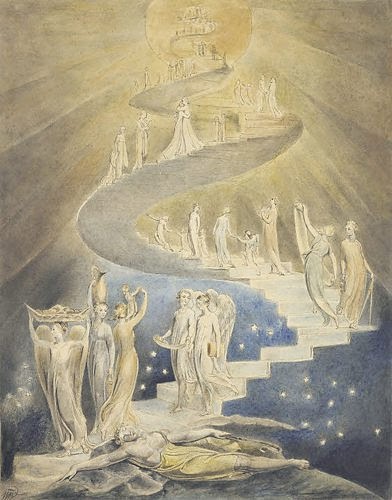 |
| William Blake, Jacob's Ladder |
"I've known a Heaven, like a Tent" (F257)"
"'Heaven'—is what I cannot reach!" (F310)
"The nearest Dream recedes—unrealized—" (F304)
If Vendler's reading is correct, and the last stanza has people worshipping poets, it is almost droll. We can see the sun, we can enjoy a summer's day, but Heaven? We take that on faith – and that springs from the poets. When we worship "the Heaven of God" aren't we really worshipping an image described by poets such as Dante and Blake, and thereby worshipping them? No wonder Poets come first!
If Heaven is a poetic concept and not an actual place, the Grace needed to attain and maintain "the Dream" of it is still going to be too "difficult". You think you've glimpsed it, but then it disappears, leaving "But just the miles of Stare – / That signalize a Show's Retreat –" (F257). As Vendler claims, the last stanza is exceedingly heretical!


