Search This Blog

30 June 2014

For largest Woman's Heart I knew —

For largest Woman's Heart I knew —
'Tis little I can do —
And yet the largest Woman's Heart
Could hold an Arrow — too —
And so, instructed by my own,
I tenderer, turn Me to –
                       F542 (1863)  J309


Dickinson sent one copy of this poem to Sue, her sister-in-law and beloved (although at times estranged) friend. The short poem is full of mystery. Why is the first line in the past tense? What is it that the poet might want to do while seemingly regretting that there is "little" she can do? What sort of arrow is Dickinson envisioning: a Cupid's arrow of love or the sharp arrow of pain and grief? The heart can hold an arrow "too" – what else did it hold? And finally, how is one to complete the last thought?
  
Woman defending herself against Eros
by William Adophe Bouguereau (about 1880)

One reading might have Dickinson writing directly to and of Sue. She has the largest heart. Perhaps it is so large that Dickinson finds herself rattling around in it along with myriad others and there is not much she can do about it. Yet despite the (gossiped about) flirtatious nature of Sue, she could harbor Cupid's dart. Instructed by her own heart, the poet, feeling more sympathetic by this contemplation, turns herself to … perhaps to her own rich inner life or to a philosophical and generous understanding and acceptance of Sue.

I’m not sure what the honymic rhyme of "too" with "to" adds to the poem, but it doesn't seem accidental. 

Any comments on this poem are indeed welcome!

28 June 2014

The Test of Love — is Death —

The Test of Love — is Death —
Our Lord — "so loved" — it saith —
What Largest Lover — hath
Another — doth —

If smaller Patience — be —
Through less Infinity —
If Bravo, sometimes swerve —
Through fainter Nerve —

Accept it's Most —
And overlook — the Dust —
Last — Least —
The Cross' — Request —
                                                     F541 (1863)  J543

 Readers in Dickinson's devout Protestant community would have been quite familiar with the Bible; consequently they could easily flesh out the well-known New Testament verses this poem draws from. Without these verses the poem seems sketchy; with them, we find the poet asking for toleration and perhaps forgiveness in the name of love.
The first line about the "Test of Love" draws on John 3:16: "For God so loved the world, that he gave his only begotten Son, that whosoever believeth in him should not perish, but have everlasting life." Another relevant New Testament text is John 15:13 – "Greater love hath no man than this, that a man lay down his life for his friends."
Having established that the willingness to die – or have the "only begotten Son" die – proves Love, Dickinson claims that what God or Jesus, the "Largest Lover", has done, a person can do as well. She hastens to qualify this, however. A human has "smaller Patience" simply because human lives are short (a nice insight); we have less courage because of "fainter Nerve". So although we might think we would do everything for another, even to the point of death, our human frailties get in the way.
   
Soul of the Sunflower, 1870, Elihu Vedder

The last stanza seems to me to switch from a general discussion of divine versus human to a direct request. A paraphrase of the first two lines might read: Accept that humans can be mostly (but not perfectly) loving, patient and brave; "Overlook" human frailty. So far so good. But what of the last two lines? Here Dickinson refers to other New Testament teachings. "Least" draws from Matthew 25:40, where Jesus claims, in a parable about helping the neediest people, that "Inasmuch as ye have done it unto one of the least of these my brethren, ye have done it unto me."  
        The cross' request, perhaps the "Last" thing that Jesus said, would be one of the seven  sayings  that Jesus reportedly made as he was being crucified. Of these, only one can be considered a true request: from Luke 23:34 – "Father, forgive them, for they do not know what they do." Dickinson may be exhorting her readers to be more tolerant, loving, and forgiving; but to my ear it sounds as if she is asking for a bit of forgiveness herself. Perhaps her patience faltered and she lacked a bit of courage. I am one of the least, she says; I've failed in some way, but I would still die for you. Remember the lessons of the New Testament. Understand, forgive, and still love me.
        I struggled with this poem until reading it as a personal plea from the poet. As a general discussion it seems disjointed, even annoying. As a heartfelt plea, though, I find it moving and even beautiful. The last line calls out in the name of the cross of crucifixion – which might have been schmaltzy but with the bareness of the lines, the number of words and phrases left out, it has more poignancy than pathos.

Each line in the first stanza ends in a slant rhyme of "Death" – a quiet sound that contrasts with the abundance of "L" sounds: Love, Lord, loved, Largest, Lover". The contrast of a complex even difficult sound (the "L", dropped or missing from many languages and language variants, seems unfinished, the tongue poised behind the upper teeth as if ready to spring into a new sound) with the long, quiet fricative "th", emphasizes the end words. "Death" casts a shadow over the entire first stanza until the final word, "doth."
        The second stanza trips by more quickly with an AABB scheme and the fast perfect rhyme of "swerve" with "Nerve". The third stanza reverts to the AAAA slant-rhyme pattern of the first. Once again the end words are emphasized, not only by rhyme but by the decisive sibilance of the "st" sounds. The final word, "Request," which I argue is the point of the poem, is doubly emphasized in picking up both the long "e" of "Least" as well as the slant rhyme with "Most" and "Dust."

02 June 2014

If What we could — were what we would —

If What we could — were what we would —
Criterion — be small —
It is the Ultimate of Talk —
The Impotence to Tell —
F540 (1863)  J407

Some might call it griping, others wishful thinking, still others confiding. No matter what you call it, I think Dickinson nails it here. Sharing what you want but don't have is "the Ultimate of Talk". It's how we sort out our priorities, discuss strategies and alternatives, take or give consolation, bond with friends, gain encouragement, or simply vent.
        Doing or getting what you want, on the other hand, might be rewarding and satisfying, but it doesn't make for great conversation unless you are phoning home. Dickinson didn't live in a culture that valued boasting – and neither do we, except for brag-rappers or professional wrestlers. And then again, fulfillment, like virtue, is its own reward. 

Confidence, Daniel Ridgway Knight, 1899
The concept of the poem seems simple, but try to say as much as concisely. Dickinson does so through eclipsis (leaving out words) and parallel structure. Textbook grammar might suffer but textbooks be damned! The sense of the poem is clear, and a sentence such as "It is the Ultimate of Talk – / The Impotence to Tell –" is just fun. The phrase rolls off the tongue and then the mind enjoys a bit of a romp to sort it out. 
        Dickinson pairs "the Ultimate" with "The Impotence" and follows both with a short prepositional phrase: "of Talk" and "to Tell". The parallelism is capped by the fun word "Impotence" – a stuffy sounding word that, at least to modern ears, suggests a very particular type of inability to get "what we would".
        The parallelism of the first line sets the lighthearted tone of the poem with its singsong cadence and multiplicity of "w" sounds: what, we, were, what, we, would. The last two lines trip to "t" sounds: It, Ultimate, Talk, Impotence, to, Tell. 

30 May 2014

Delight — becomes pictorial —

Delight — becomes pictorial —
When viewed through Pain —
More fair — because impossible
That any gain —

The Mountain — at a given distance —
In Amber — lies —
Approached — the Amber flits — a little —
And That's — the Skies —
                                   F539 (1863)  J572

This poem continues the dialectic between pleasure ("Delight") and pain that she explored in the previous one.
        Each of the two stanzas examines perceptions from a distance. Through the lens of pain, delight becomes something beautifully rendered as if it were a painting. It is "More fair" because it seems unattainable. Distant mountains bask in an amber glow (and Dickinson is partial to amber, using it to suggest beauty in twenty-four poems. Viewed more closely, however, the glow is seen to be not some radiant quality of the mountain itself but simply a trick of the skies. Up close the amber "flits", revealing its ephemeral quality. It is illusory rather than real.

Dickinson employs an interesting variation on the ballad meter, alternating iambic tetrameter with iambic dimeter: four feet alternating with two feet (rather than four alternating with three). The effect is to give more punch to the dimeter lines. "And That's – the Skies –" can almost be read as a punch line.
William Louis Sonntag,
"VIew in the White Mountains" 1888

Typically mountains seem blue-ish in the distance unless it is sunset or sunrise. Dickinson didn't travel much but she was well read, was interested in art, and listened to travelers. White Mountain art was extremely popular throughout her lifetime and, like artists from the Hudson River school, the artists often clad the hills and mountains of New Hampshire in an amber glow.
          Among the notable artists painting the White Mountains at the time were Albert Bierstadt, Thomas Cole, Asher Durand, Winslow Homer, George Inness, John Frederick Kensett, and Benjamin Champney. No doubt Dickinson would have seen some of their work. 

27 May 2014

Must be a Woe —

Must be a Woe —
A loss or so —
To bend the eye
Best Beauty's way —

But — once aslant
It notes Delight
As difficult
As Stalactite

A Common Bliss
Were had for less —
The price — is
Even as the Grace —

Our lord — thought no
Extravagance
To pay — a Cross —
                                                    F538 (1863)  J571

This poem comes to a screeching halt for me at the word "Stalactite". Words such as slow, tenacious, subterranean, or accretive are what I think of when describing the thing – none of which add much to the second stanza. Dickinson uses eclipsis (leaving out words) throughout the poem to generally good effect, particularly in the last stanza, but it doesn't help the Stalactite Problem. So, good readers, give me your thoughts. Please tell me it isn't just that it rhymes with "Delight."   

        Meanwhile I'll start by saying that Dickinson treats the issue of pleasure and gain from pain and vice versa in several poems but none so powerfully (as far as I know so far) as in F772:
Essential Oils—are wrung—The Attar from the RoseBe not expressed by Suns—alone—It is the gift of Screws—  


Here, the first and third stanzas are anodyne claims that pain enables the recognition of beauty, but the enjoyment of common happiness requires much less grief. She introduces, however, the idea of "Grace" in the third stanza after suggesting that once woe has enabled the perception of beauty it, perception becomes "aslant" and delight more difficult. The introduction of "Grace" takes the poem to the theme of sacrifice with which she ends the poem.
      Once again Dickinson employs a metaphor from the marketplace. The price of bliss – which is pivoted to Grace – reflects the degree of suffering or Woe. The greater the suffering the greater the Bliss/Grace. It's a dollar-for-dollar deal. The thought is carried into the final stanza which might be paraphrased as "Jesus didn't think the price he paid (being crucified) for the salvation of humanity was extravagant." 

I think the success of this poem lies in the shorthand Dickinson employs. It makes the poem choppy. It seems simple, even childlike. The Stalactite reference underscores this for me. But all that makes the ending more powerful. We are reading and nodding our heads: yes, pain digs the well that happiness can fill – and of course Kahil Gibran's lovely "On Joy and Sorrow" from The Prophet (written a few years after Dickinson died) elaborates on the same theme. But then in trying to fill in the eclipsis we realize that in Christian theology our salvation requires the torture death of the God/Man Jesus. Again, this is hardly an original idea but Dickinson lends it power through her stripped-bare verbiage. The reader, forced to fill in the blanks, comes to the realization anew.

26 May 2014

I could die — to know —

I could die — to know —
'Tis a trifling knowledge —
News-Boys salute the Door —
Carts — joggle by —
Morning's bold face — stares in the window —
Were but mine — the Charter of the least Fly —

Houses hunch the House
With their Brick Shoulders —
Coals — from a Rolling Load — rattle — how — near —
To the very Square — His foot is passing —
Possibly, this moment —
While I — dream — Here —
                                              F537 (1863)  J570

Mornings are busy at the Dickinson Homestead. The paper boys "salute" the door (is this a droll way of saying they throw the paper against the door just as they do today?) with the morning news, carts "joggle" by with their loads, coals rattle on and off their conveyance. Meanwhile the morning sun stares in the poet's window and neighboring houses hunch against hers as if hemming her in. 
Coal carts being loaded for delivery

      Amid all this daily hustle and bustle our poet is dreaming of her beloved. She is dying to know where he is right now – trifling knowledge indeed since he is probably on his way to work. She is particularly frustrated because even the "least Fly" could buzz around and find him if it wanted. Alas, as a Victorian woman, she must content herself with dreams. Fortunately this quaint habit of female rectitude has long gone by the wayside. 
      But Dickinson often prefers to imagine and dream rather than dive into the real. She refused to see Samuel Bowles once when he came calling, despite her likely deep affection for him – and her copious output of letters and poems directed to him. She refused to marry Judge Lord despite a similar deep affection for him. In several previous poems she writes of deferring love and union until some afterlife. (Other times, she admits skepticism that such union would ever take place.) Perhaps most strikingly, she went for about thirteen years without visiting her childhood best friend, sister-in-law, and next door neighbor Sue –a dear beloved despite their fallings out and estrangements – all the while sending her notes and writing poems to and about her. 

This is a delightfully vivid poem and Dickinson writes with a light touch. We have the busy-ness of carts and paperboys contrasted with the staring sun and hunching houses with their marvelous "Brick Shoulders". Is the speaker going to go out in the world or hunker down with the hunching and staring? The last line, "While I – dream – Here ¬–" is a clear indication she is going to stay home. The line is drawn out with dashes and long vowels. It is a dreamy, staying-put line, wistful but not unhappy. 

25 May 2014

Some — Work for Immortality —

Some — Work for Immortality —
The Chiefer part, for Time —
He — Compensates — immediately —
The former — Checks — on Fame —

Slow Gold — but Everlasting —
The Bullion of Today —
Contrasted with the Currency
Of Immortality —

A Beggar — Here and There —
Is gifted to discern
Beyond the Broker's insight —
One's — Money — One's — the Mine -
                          F536 (1863)  J406

While some people aim for the "Slow" but "Everlasting" gold of immortality, most work for what can be earned today. Laborers toil for their hourly wage, and lawyers'  – noting that Dickinson's father and brother were both lawyers – time is billable. Those on the Immortality track (poets perhaps?) receive "Checks – on Fame", that is, promissory notes or vouchers payable byFame.
      Dickinson makes three comparisons between the Immortality folks and the work-for-pay set, one in each stanza. In the first those whose time is worth money are contrasted with those whose reward is intangible. The reliance on Fame seems a bit dicey: she is a fickle mistress after all. A poet might dedicate her life to immortal issues and never enjoy a shred of fame. 
      In the second stanza Dickinson makes a better case for Immortality. It offers gold, albeit a "Slow Gold". The phrase is a spondee: two accented syllables that emphasize both. But while the gold may not shower down, it is everlasting. Time workers, in contrast, get paid in the "Bullion of Today" and this seems like petty cash compared to the "Currency / Of Immortality". 
Gold bullion, photo by Antony Theobald

      Dickinson saves her most powerful comparison for the end. She compares the beggar's superior insight (or at least a beggar "Here and There") to that of the broker's. While brokers may understand a wide and complex variety of financial transactions, a beggar is sometimes "gifted" with the insight that it is the earth that creates the wealth, not the mint; it is the thinker, visionary, prophet or poet who taps into the deep and the immortal, hereby creating meaning that the rest of us draw on. The last line is marvelously clever and concise.
      I suspect Dickinson was indeed thinking of the poet (including herself) as well as her friends who were writers, philosophers, and social activists. Of them all, she was perhaps the beggar for those she knew – Higginson, Bowles, Wadsworth, even Emerson – all received fame and respect in addition to the bullion of the day.

14 May 2014

It might be lonelier

It might be lonelier
Without the Loneliness —
I'm so accustomed to my Fate —
Perhaps the Other — Peace —

Would interrupt the Dark —
And crowd the little Room —
Too scant — by Cubits — to contain
The Sacrament — of Him —

I am not used to Hope —
It might intrude upon —
Its sweet parade — blaspheme the place —
Ordained to Suffering —

It might be easier
To fail — with Land in Sight —
Than gain — My Blue Peninsula —
To perish — of Delight —
                                      F535 (1863)  J405

Dickinson presents two contrasting states of being in this paradoxical poem. One is a difficult status quo and the other is an imagined state of union with the beloved.
The status quo doesn't seem very appealing: the speaker has a small room, dark and filled with loneliness; like a cell in a strict and austere convent, it has been "Ordained" by its occupant to be a place of suffering. In the last stanza we see her at sea in danger of drowning but within sight of land. 
        Each of these conditions has its possible opposite, and the speaker ponders these potentialities. Instead of "Loneliness" – her "Fate" – she might have "Peace". This peace, however, seems contingent upon the presence of "Him" – a beloved person, potential lover, or perhaps a godly lover. The paradox is that loneliness has become such a real presence that "It might be lonelier" without it. The peace radiated by the beloved's presence would disrupt the darkness of her "little Room"; additionally, his presence has a holy, sacramental quality that would crowd the space. Finally, "Hope" with its "sweet parade" might "intrude", even "blaspheme" the lonely suffering. 
        In the last stanza the beloved is seen as a sort of paradise, a "Blue Peninsula". To gain it would be death by "Delight". The beauty of this last image conjures up not only Paradise but the perfect lover. 
        The beauty of the poem as a whole is that it may be read as a struggle against the seductions of religion – Christianity with its heaven and the man/god Jesus, as well as the seductions of a human beloved. Ultimately, the poet would rather have the struggle than the fulfillment.

        Much of the language is Biblical and Christian: American readers of any era know "Cubits" only as the unit of measurement used by God when specifying the dimensions of the ark to Noah. The language of sacrament and blasphemy is also Christian. A nun is considered a bride of Christ, and the speaker presents herself as nun-like. And finally, in previous poems, Dickinson has used the imagery of the sea as the soul's journey to the distant shore of heaven (e.g., "On this wondrous sea – sailing silently" [F3]). Here, the speaker would rather go down with heaven in sight than surrender to its all-encompassing possession. That reminds me of F533 where Heaven entails "too difficult a Grace – / To justify the Dream".
        She has also used the sea as a metaphor for passion (e.g., "Wild Nights – Wild Nights!" [F269]). We might read, then, her "Blue Peninsula" as a beloved man whose very presence is paradisical. To be joined with him would be to deny everything she has come to be; it would be a death of sorts, although a blissful one. A poet might well prefer the dark canvas of loneliness, to press her breast against the thorn to sing (can't remember whose image this was – Shakespeare or Pope?) to a parade of hope and a room crowded with the profound love she considers would be like living with a sacrament.

The tone of the poem is as ambiguous as the imagery. It might be read as bitter irony or a haunting sadness; it might just as well be read as an honest and contemplative assessment of her choices and decisions. After all, Dickinson did indeed opt for the small room over either Christian salvation or marriage.
The tone is developed through the quiet statements that seemingly introduce an element of doubt: "It might be lonelier", "It might intrude upon", "It might be easier". These prosy constructions introduce and contrast with the imagistic states of being: a little dark room, lonely or crowded; a sacrament, a parade of hope that is "sweet" but also blasphemes, a blue peninsula.
I like the poem's harmonics. I like how it builds to that achingly beautiful last stanza.

03 May 2014

How many Flowers fail in Wood —

How many Flowers fail in Wood —
Or perish from the Hill —
Without the privilege to know
That they are Beautiful —

How many cast a nameless Pod
Upon the nearest Breeze —
Unconscious of the Scarlet Freight —
It bear to other eyes —
                                F534 (1863)  J404


In this sentimental poem, Dickinson reflects on how unaware of their own worth people can be. Some like flowers bloom and perish in the quiet backwaters of Wood and Hill. Did they really not know whether or not they were "Beautiful"? Dickinson wonders if they had "the privilege to know", and in the usage of her day "privilege" here would probably mean the opportunity or chance to know. 
        I doubt that Dickinson is referring to physical beauty. That's one sort of self knowledge we gain early, unless we are raised in a hermitage. Inner beauty, however, almost by definition is only seen by discerning others. Perhaps Dickinson is imagining a small village with a beautiful soul or two but without anyone who might convince them of that – or perhaps would even notice.
        The second metaphor for unseen worth is that of a flower pod carried by a breeze to disseminate its seeds. This is clearly a reference to all the good things – the seeds –  planted by simple words and gestures, an act of kindness, years of careful devotion and attention – all the actions that are ultimately nurturing and generative. It is a very feminine image. A good soul casts such pods throughout life without even realizing the effect they have on others. 
        Because Dickinson specifies the effect of the pods on others as "Scarlet Freight" born to the eyes, it may be that she is (also) talking about poetry. Poems are visual, most times. That Dickinson considers they deliver some heavy freight has been discussed in earlier discussions here and quite extensively elsewhere. I think it likely that the brilliant red maple achene, the samara, is the pod she is visualizing. It's a lovely image: the graceful maple tree dispersing its winged seeds in the breeze. Granted the achenes are not pods, but "Pod" is just such a fine word, I would never quibble with it. (A commenter mentioned a couple of uses of "pod" in recent poems – and here is a third.)


Dickinson touches on a similar theme in "Except to Heaven, she is nought" (F173). In that poem she writes of a small flower that is not valued by any except Heaven and the tiny creatures who benefit from it. I read that poem as a metaphor for a woman, perhaps Dickinson herself. Except to the bees, butterflies and breezes who recognize her beauty and importance, the little flower is "superfluous" and "provincial"; as a result, she is "lone" and "unnoticed".  
        I don't find the tone in either that poem or this one to be anything but sweetly, wistfully sentimental. There are quiet souls to be appreciated, perhaps in contrast to men like the poet's opinionated father and brother or the well-traveled and lionized men that were her favored correspondents. These men certainly were aware of their "beauty" and the impact of their pods. But doesn't it sound odd to phrase it like that? Our thoughts turn immediately to the housewives who die sad, quiet, early deaths in other Dickinson poems.

01 May 2014

I reckon — When I count at all —

I reckon — When I count at all —
First — Poets — Then the Sun —
Then Summer — Then the Heaven of God —
And then — the List is done —

But, looking back — the First so seems
To Comprehend the Whole —
The Others look a needless Show —
So I write — Poets — All —

Their Summer — lasts a solid Year —
They can afford a Sun
The East — would deem extravagant —
And if the Further Heaven —

Be Beautiful as they prepare
For Those who worship Them —
It is too difficult a Grace —
To justify the Dream —
                                    F533 (1863)  J569

Dickinson reckons – counts or calculates – that what truly matters are Poets, the Sun, Summer, and Heaven. It's a short list, all of which, however, is encompassed in Poets, for in their vision and art is a type of deep Platonic truth, one springing from the imaginative world. The actual items (Sun, Summer, Heaven) are but a "needless Show", their glories subject to weather or the difficult demands and vagaries of a supposed deity. It is a powerful and confident paean to poetry and to the visionary poets whose truths endure – and one must conclude that Dickinson includes herself in that company. 
        Her own poetry distills the essence of Sun and Summer in numerous poems, and as she points out, a poet's summer can last "a solid Year". (Helen Vendler in Selected Poems and Commentaries claims that Dickinson is making droll reference to a couple of Shakespeare's sonnets in this stanza – e.g., "thy eternal summer…"). In many of her poems the other seasons represent some kind of pain, so it is no surprise that Dickinson singles out summer as an apex experience. For example, along with rebirth, Spring brings the aching realization of loss ("I dreaded that first Robin, so" [F347]). Autumn is a bittersweet season of beauty and sadness whose red leaves conjure up dresses and scarves – but also blood ("the name – of it – is 'Autumn'" [F465]). Winter, if not death, is a numb despair ("There's a certain Slant of light" [F320]). In contrast, Summer is fullness and creation: There is "A something in a summer's noon … / Transcending ecstasy" [F104]. The Sun precedes Summer in the list, as well it should, for Summer is the Sun's daughter.
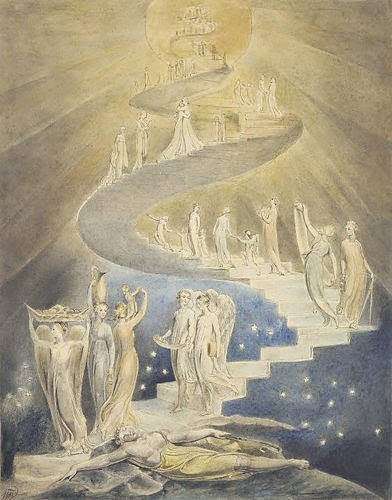
        "The Heaven of God" trails along and is dismissed as something not worth the effort needed. The last stanza is a bit difficult and scholars don't agree on some key points (such as who the "they" and the "Them" refer to). I like Vendler's reading, so I loosely summarize her discussion of it here: Many poets have written of Heaven, creating something beautiful. This contributes to – if not creates – the dream of Heaven, but Dickinson warns that the "Grace" needed to get there is so difficult that the dream isn't justified. In previous poems, Dickinson finds Heaven so frustrating or ephemeral that it is no wonder she finds it fails to  "justify the Dream". 


William Blake, Jacob's Ladder
"I've known a Heaven, like a Tent" (F257)"
"'Heaven'—is what I cannot reach!" (F310)
"The nearest Dream recedes—unrealized—" (F304)

        If Vendler's reading is correct, and the last stanza has people worshipping poets, it is almost droll. We can see the sun, we can enjoy a summer's day, but Heaven? We take that on faith – and that springs from the poets. When we worship "the Heaven of God" aren't we really worshipping an image described by poets such as Dante and Blake, and thereby worshipping them? No wonder Poets come first!  
        If Heaven is a poetic concept and not an actual place, the Grace needed to attain and maintain "the Dream" of it is still going to be too "difficult". You think you've glimpsed it, but then it disappears, leaving "But just the miles of Stare – / That signalize a Show's Retreat –"  (F257). As Vendler claims, the last stanza is exceedingly heretical!

21 April 2014

The Winters are so short —

The Winters are so short —
I'm hardly justified
In sending all the Birds away —
And moving into Pod —

Myself — for scarcely settled —
The Phoebes have begun —
And then — it's time to strike my Tent —
And open House — again —

It's mostly, interruptions —
My Summer — is despoiled —
Because there was a Winter — once —
And all the Cattle — starved —

And so there was a Deluge —
And swept the World away —
But Ararat's a Legend — now —
And no one credits Noah —
                                           F532 (1863)  J403

Cynthia Griffin Wolff proposes Nature as the speaker of this lighthearted poem (Emily Dickinson, 284-5). After all, it is Nature who causes the birds to migrate and puts the developing seed into pods; Nature who hibernates in her tent until time to have summer "open House – again". 
        One could easily read the poem's speaker as Dickinson herself. Most of the first three stanzas can be plausibly read as from her point of view. This wouldn't be the first time she has placed herself at the hub of the seasons, perhaps most notably in "I dreaded that first Robin, so" (F347) where the creatures and blossoms of spring arrive punctually "in gentle deference" to her and then salute her as they depart. But why would she ramble on here about cattle and floods?
        I'm drawn to Wolff's idea, but would refine the voice as stream of consciousness from an exasperated and rather flighty Mother Earth. Mother gets frustrated with all the "interruptions", with how fast time flies ("What's the sense of sending off birds and tucking myself in for the winter? I just get comfortable and then the Phoebes are back! Now I have to get everything ready again.")  
        She has other complaints, too. Her precious Summer has been "despoiled" because a harsh winter ("Oh, I don't remember when … Once …) killed the cattle. That means no gamboling little calves and no fresh milk. And also, she continues, dredging up old grudges against whatever idiot is in charge of weather, there was that big deluge that drowned the world, that flood where Noah packed all the animals into an ark. "But no one believes that story anymore." I hear the housewife complaining about the husband making her job harder and the lamentable views of the modern world.
        No matter who the speaker is, the liveliness and pertness of the voice add a lot of charm. 

The poem is written in short-meter ballad form: abcb rhyme-scheme quatrains in iambic trimeter – except for the third tetrameter line of each stanza. This is a popular variant of the traditional ballad structure with the reverse trimeter/tetrameter structure: 4-4-3-4 syllables.) The second and fourth lines rhyme. Dickinson often uses slant rhymes and does so here. I particularly like her pairing of "Noah" with "away", which really zings the "w" sound, adding to others in the stanza: was, swept, world, now, one. "Despoiled" and "starved" have little but an "s" and an "ed" in common, but they are probably the strongest words in the poem, both in sense and sound; their uniqueness is not diminished by a closely-rhymed sound.   

18 April 2014

We learned the Whole of Love —

We learned the Whole of Love —
The Alphabet — the Words —
A Chapter — then the mighty Book —
Then — Revelation closed —

But in Each Other's eyes
An Ignorance beheld —
Diviner than the Childhood's —
And each to each, a Child —

Attempted to expound
What neither — understood —
Alas, that Wisdom is so large —
And Truth — so manifold!
                                                                F531 (1863)  J568

Dickinson begins this graceful and difficult poem as if telling a story. Two young people fell in love, indeed, learn "the Whole of Love", exploring each other and revealing themselves in stages as children learn to read. She separates each stage by dashes, slowing the poem's pace so that we linger over the words: Alphabet, Words, Chapter, Book. We imagine looks, gestures, confidences, touches, tears, and laughter. The last line of the first stanza is wistfully final. The book finished, "Revelation closed". 
Engraving by Pierre A. Cot
        As if expelled from an easy Eden, they are now on difficult terrain. No longer entwined, they see "Ignorance" in each other's eyes– but it is a "Diviner" ignorance than that of their youth, one not based in innocence and inexperience but perhaps in the awareness of otherness, of unbridgeable holy difference. 
        They try to make sense of it, talking as children do, or talking to the other as if she were a child (the poem is ambiguous here), but thought and speech no longer suffice. Neither understands.

Among other things, Dickinson reveals the pitfalls of language. Philosopher and psychoanalyst Julia Kristeva refers to the "enclosure of language" and its impediment to meaning making. The semiotic realm, to which pre-articulate children, poets, and artists have access, offers by contrast a "heterogeneity of meaning"* – a "manifold" quality of truth. Dickinson writes elsewhere of interiority "Where the Meanings, are" (F320). Even after experiencing the "Whole of Love", the lovers cannot explain themselves either to themselves or to each other. 
        In a plaintive closing aphorism, Dickinson alludes to the limit of knowledge as well as language: "Wisdom is so large – / And Truth – so manifold".  How can we hope to explore all of wisdom's vast domain? And if truth is multiple and diverse, how can we ever hope to congeal it into words? 


* Kristeva, "The Subject in Process", 1998.